Som hästterapeut som arbetar med rehabilitering har jag under åren lärt mig att hästar är fantastiskt anpassningsbara – när deras kroppar får leva i miljöer som stämmer överens med deras biologi.
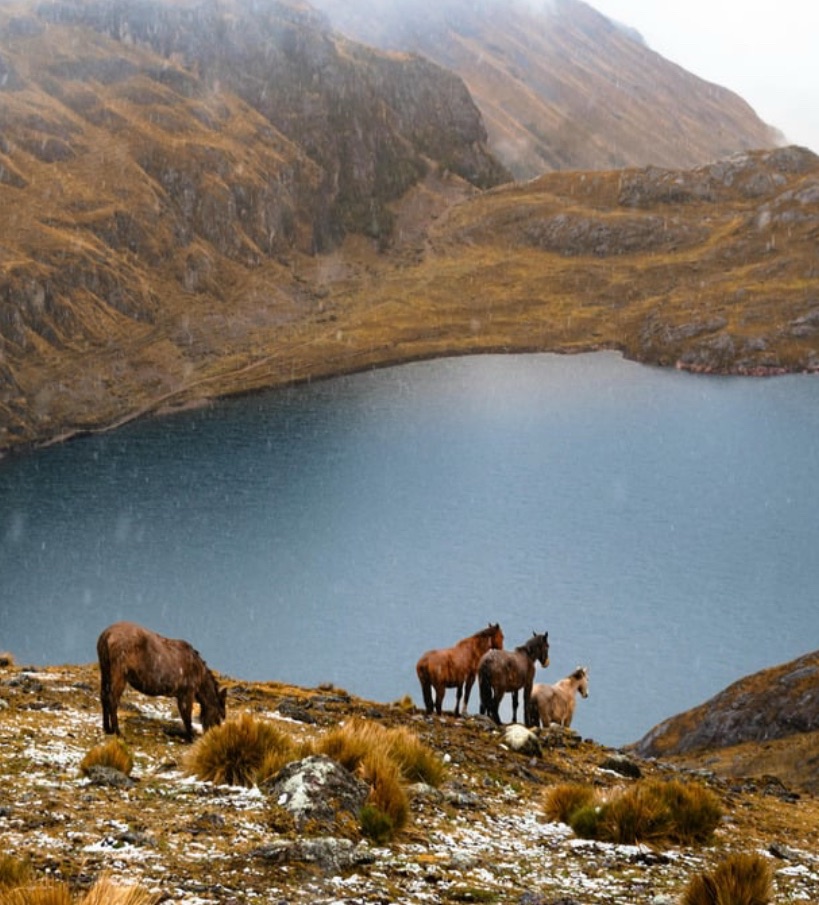
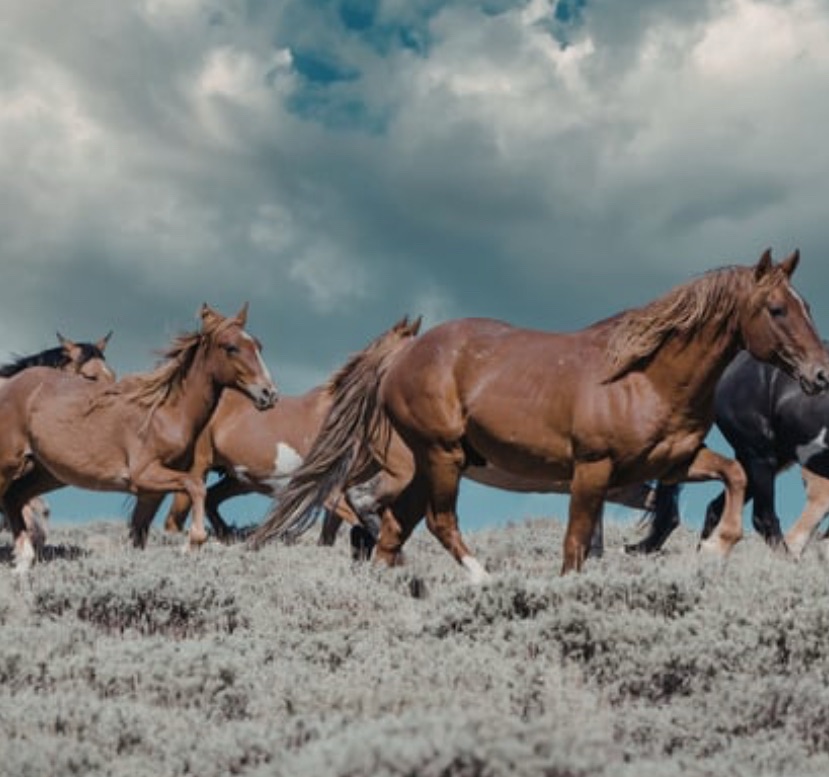
Feralhästar, alltså hästar som lever vilda, är inte “perfekta”. De möter torka, skador, rovdjur och andra påfrestningar. Men det de sällan möter är det vi ofta ser hos våra domesticerade hästar: kronisk, systematisk degeneration.
De drabbas sällan av:
Progressiv ledcollapse redan i tidig vuxenålder
Magproblem som utvecklas över tid
Metabola överbelastningar
Långvariga rörelsestörningar från felaktig hovfunktion
Beteendesuppresson från isolering
Andningsproblem från damm och stängda utrymmen
Varför?
Deras liv är organiserat kring biologisk sanning, inte människans bekvämlighet.
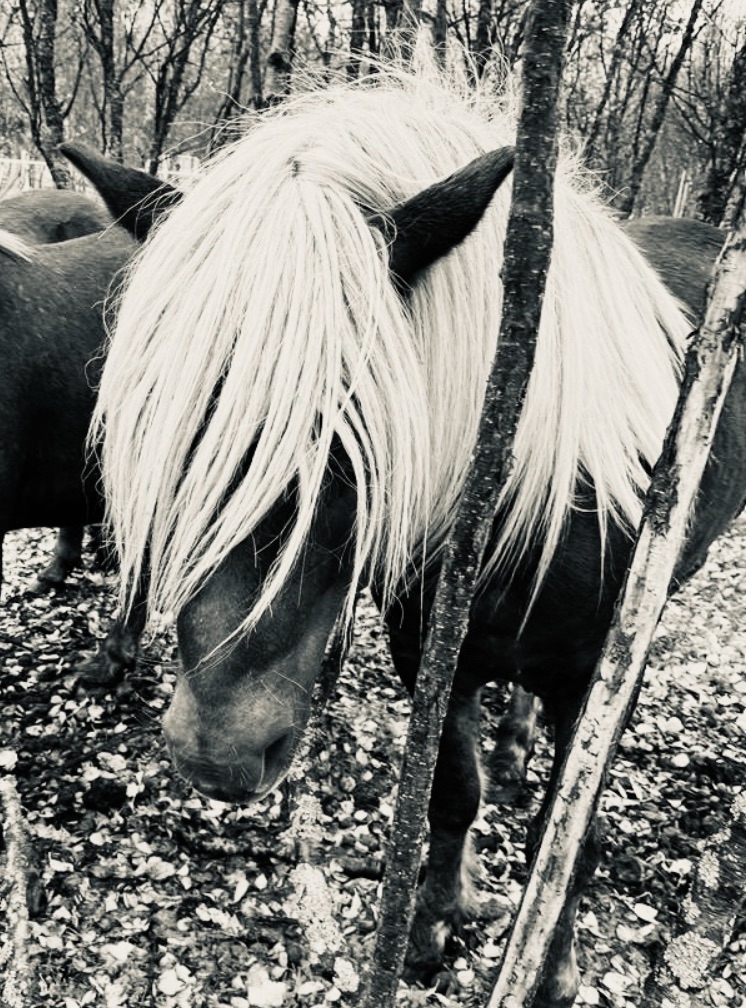
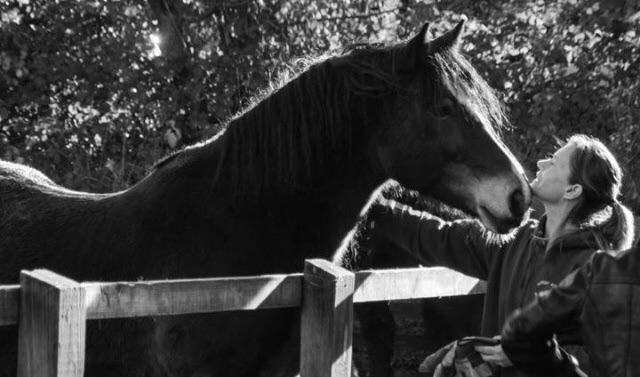
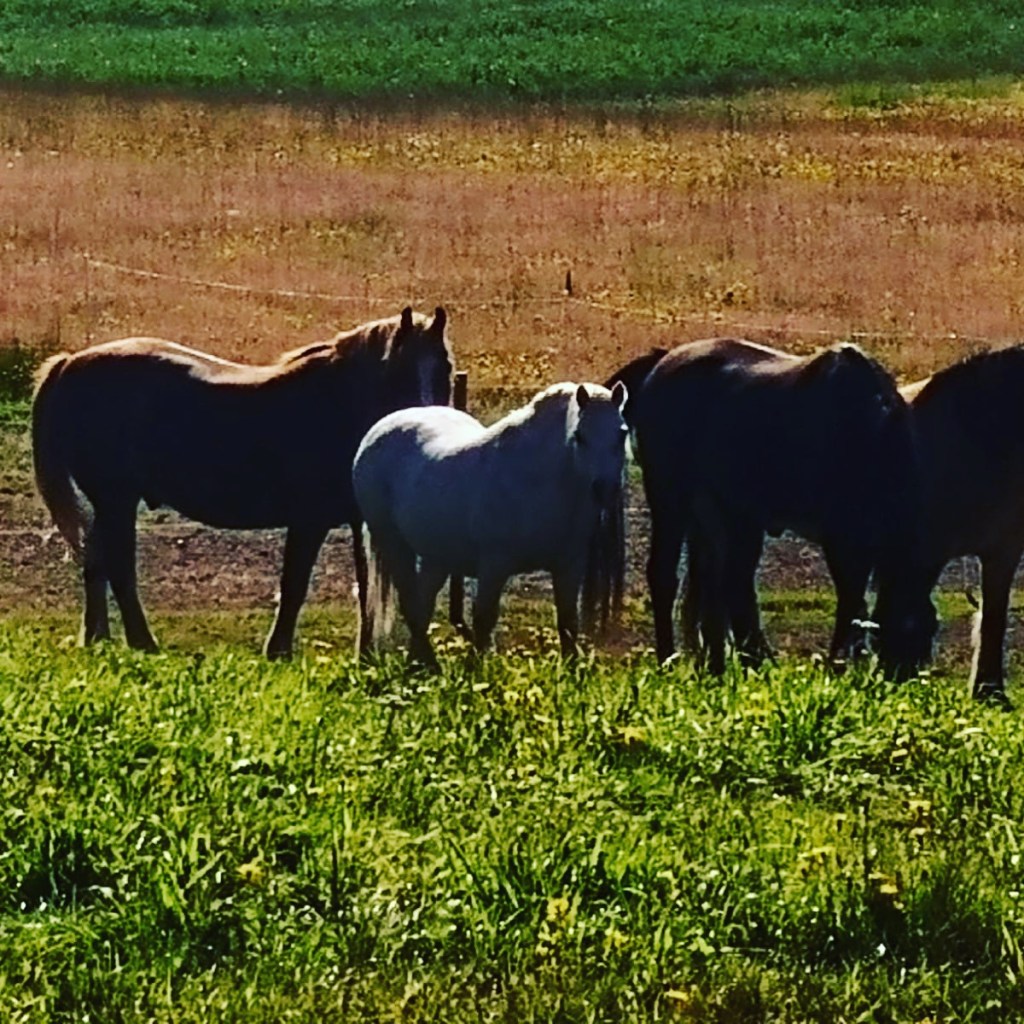
Carneddau ponnysar som jag bodde nära för många år är inte helt vilda men bor en ganska vilt liv i naturen med en liten människa koll över deras välfärd. Som jobbet håller dem balansen i naturen!
I det vilda får de:
Kontinuerlig, lågintensiv rörelse
Variation i terräng och underlag
Självvald hållning och gångart
Naturligt slitage och anpassning av hovarna
Fiberbaserad, varierad kost
Social stabilitet och valfrihet
Balans mellan vila och aktivitet
Minimala metabola toppar
Ingen påtvingad prestationskurva
Deras kroppar formas av:
Progressiv belastning, inte plötslig
Terräng som informerar struktur
Funktionell användning av muskler
Hovar som speglar verkligheten, inte teorier
Nervsystem som får återhämta sig
USAs vilda hästar är välkända och dokumenterade – vissa hingst är 30+ år gamla.
Våra domesticerade hästar lever ofta i:
Statisk miljö
Platta underlag
Intermittent, konstgjord träning
Energi-rika dieter
Social fragmentering
Hovsystem som tvingas på
Träningsmodeller som överskrider kompensation
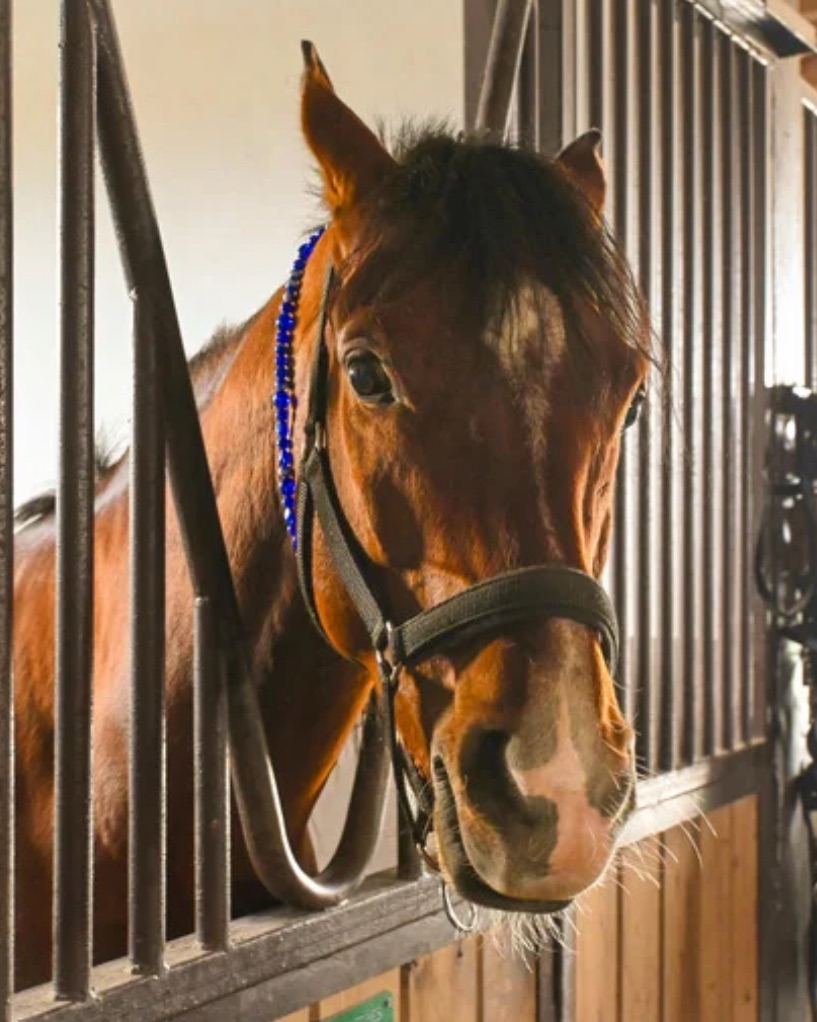
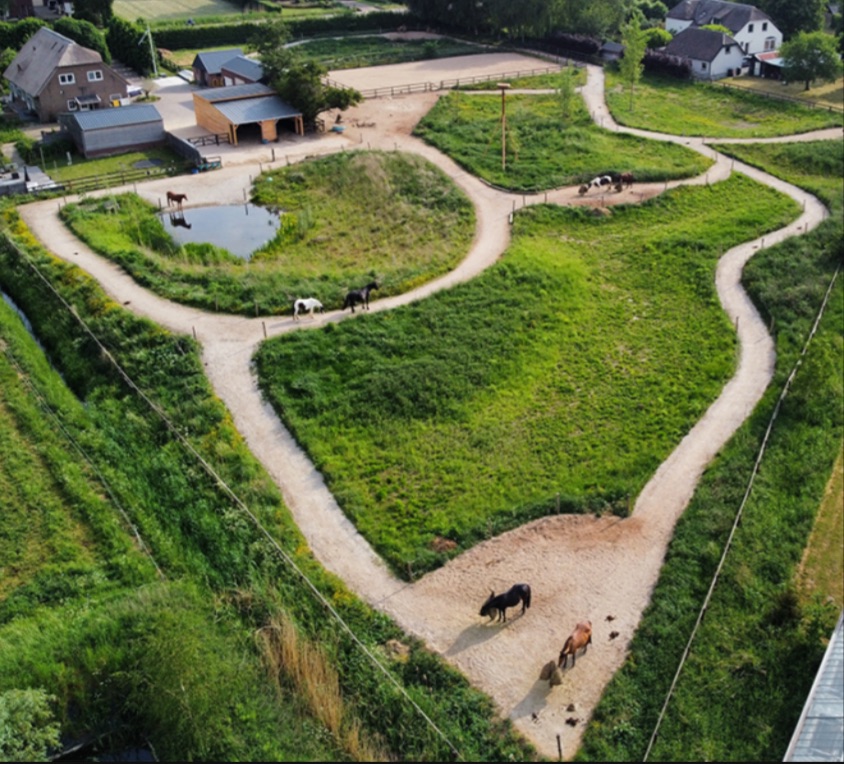
Stall miljö kan vara en krav för hästar som behöver vila pga sjukdom eller för hålla en häst när dem vänta tävling. en så kallad paradise paddock ger hästar mer rörelse och kan vara så liten som en labyrint i en sjuk hage till så stor som en hel skog eller ett berg
Lärdomen är inte att släppa varje häst fri.
Den är att hälsa uppstår ur kontext.
Vi kan ta med oss det vilda genom:
Ökad daglig rörelse via smarta hagar och spårsystem
Variation i terräng och underlag
Foderstrategier som liknar naturligt beteende
Hovvård som låter hovarna anpassa sig
Minskade metabola toppar
Respekt för vila och återhämtning
Progressiv träning
Observation av hållning, slitage och kompensation
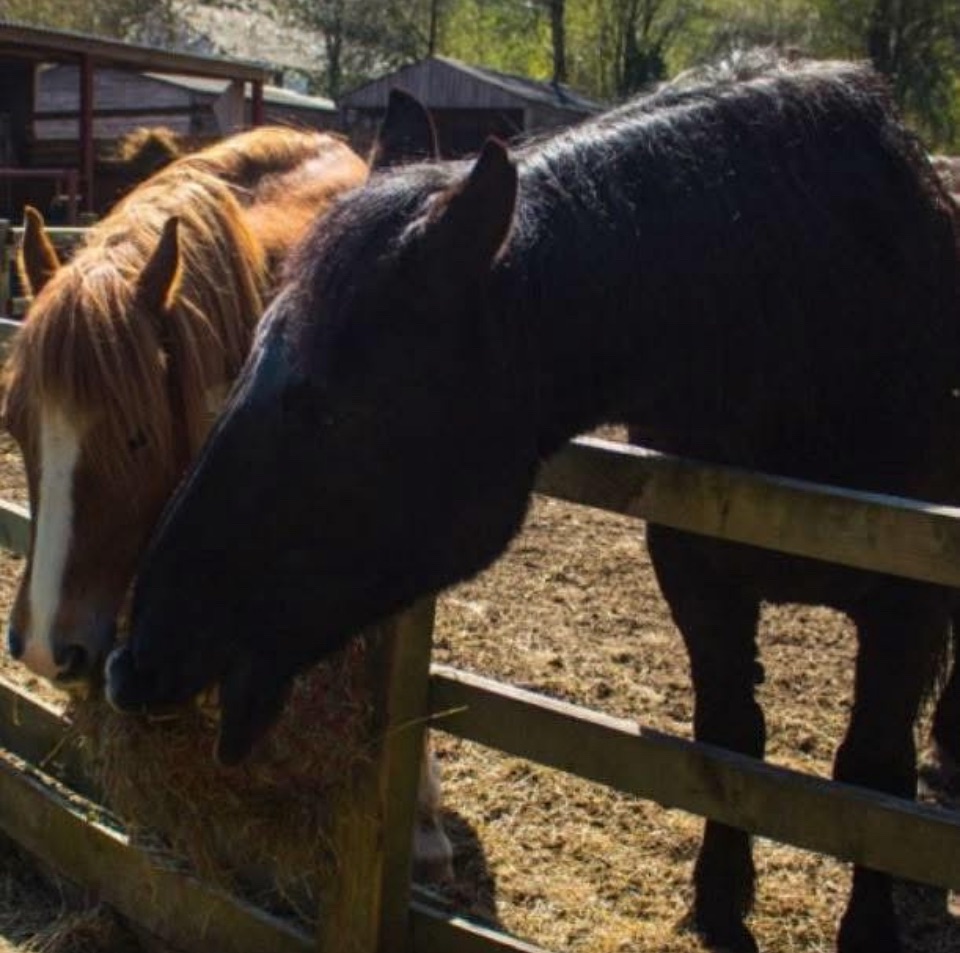
Hästar behöver kompisar som dem bor med långsiktigt och att inte flytta flocken för mycket. Flame och Havanagh var bästisar tills hon dog – tillsammans för 9 år.
Feral hästar visar oss att hållbarhet inte skapas genom intervention, utan genom anpassning mellan biologi och miljö.
Om vi vill att våra hästar ska leva längre och bättre, måste vi sluta fråga hur vi hanterar sjukdom och börja fråga hur vi kan ta bort orsakerna till den.
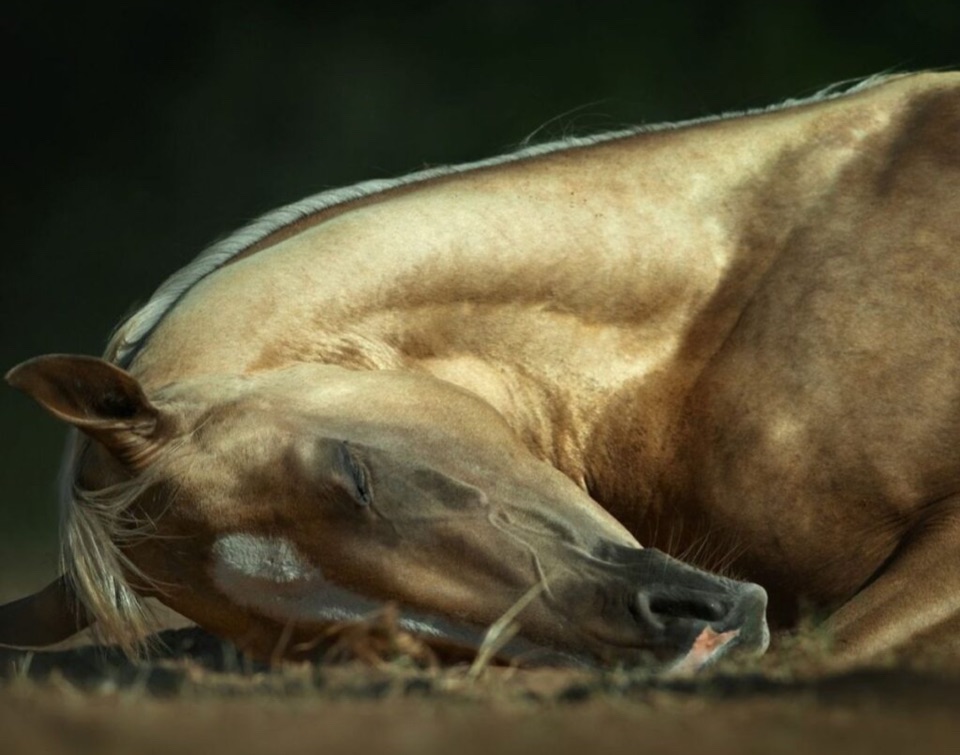
Hästar är fantastiska idrottare och lojala följeslagare, men precis som vi behöver de god sömn för att må bra och prestera på topp. Visst kan de stå och blunda under dagen, men för att nå REM-sömn, den djupa återhämtande sömnen, behöver de faktiskt ligga ner. Utan REM-sömn kan hästar bli stressade, mindre presterande, mer lättirriterade och till och med få sämre immunförsvar.
Så, hur kan vi som hästägare ge våra fyrbenta vänner bästa möjliga förutsättningar för en god natts sömn?
1. Skapa en trygg och bekväm viloplats
Hästar måste känna sig trygga för att våga lägga sig ner. Se till att boxen eller hagen är:
Tyst och inte för nära hektiska aktiviteter Ren med mjukt strö som spån eller halm Tillräckligt rymlig för att kunna sträcka ut sig ordentligt
Äldre eller försiktiga hästar kan behöva längre tid för att känna sig helt trygga. Här gäller lugnt tålamod och en stadig rutin.
2. Ha en konsekvent kvällsrutin
Hästar är vanedjur och rutiner hjälper dem att förstå när det är dags att varva ner:
Mata på ungefär samma tid varje kväll Ha förutsägbar tillgång till hage eller utegång Undvik höga ljud eller plötsliga rörelser vid viloplatsen
3. Uppmuntra avslappning i kroppen
Spända muskler kan hindra hästen från att slappna av helt. Lätt massage eller stretching före vilan kan göra stor skillnad:
Massera nacke, bogar och rygg Låt hästen sträcka på sig under avskritt eller i hagen Lugnt ljus och mjuk miljö hjälper hästen att signalera vila
4. Ge social trygghet
Hästar är flockdjur och många sover bättre när de ser, hör eller känner en vän. Om möjligt:
Ha en trygg kompis i närheten Om full kontakt inte går, se till att de åtminstone har delvis synkontakt
5. Tänk på ljus och nattsituation
Hästar är dagsaktiva, och ljus påverkar melatoninproduktionen, som styr sömnen.
Sänk ljuset på kvällen Undvik plötsliga starka lampor Se till att det är dragfritt men ändå ventilerat — bekvämlighet är viktigt
6. Håll koll på liggande beteende
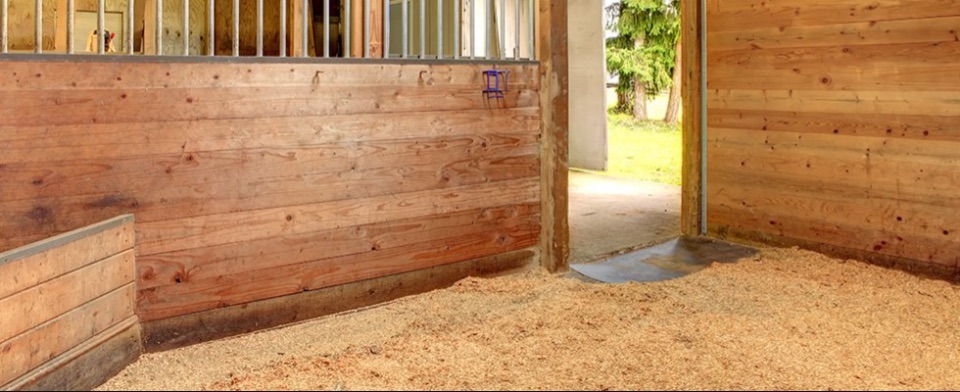
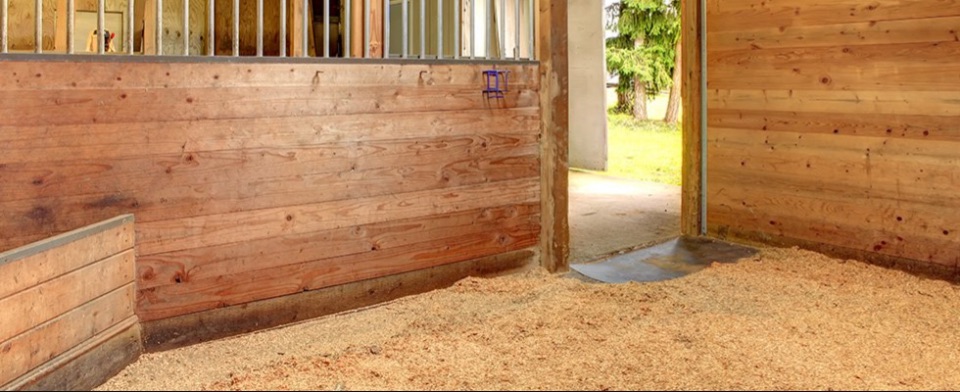
en bekväm underlag göra mycket
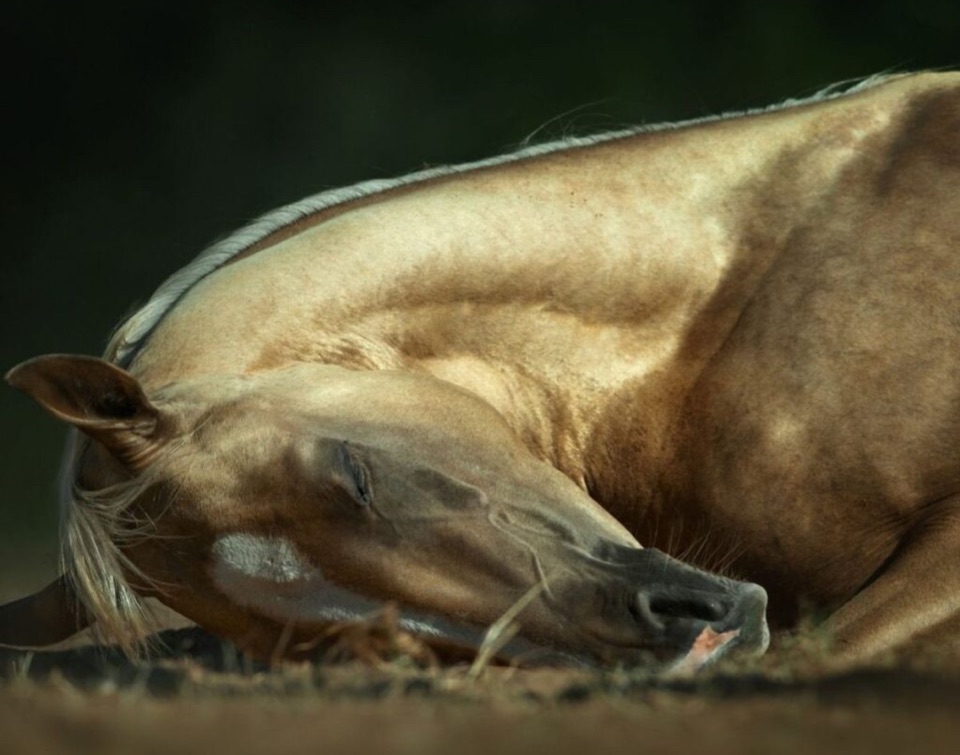
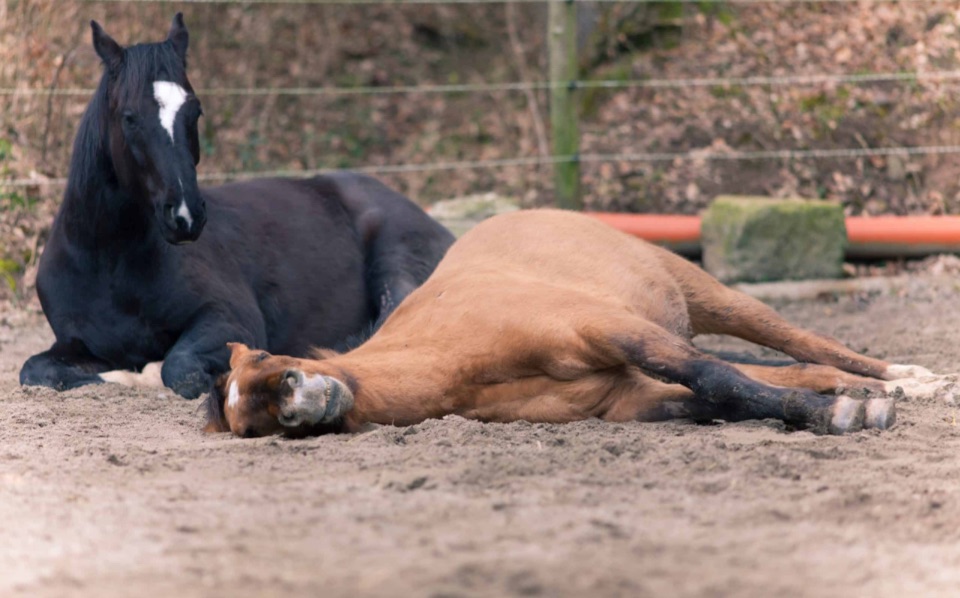
För att uppnå REM-sömn behöver hästar ligga ner, ofta bara några minuter åt gången men med stor betydelse. Observera:
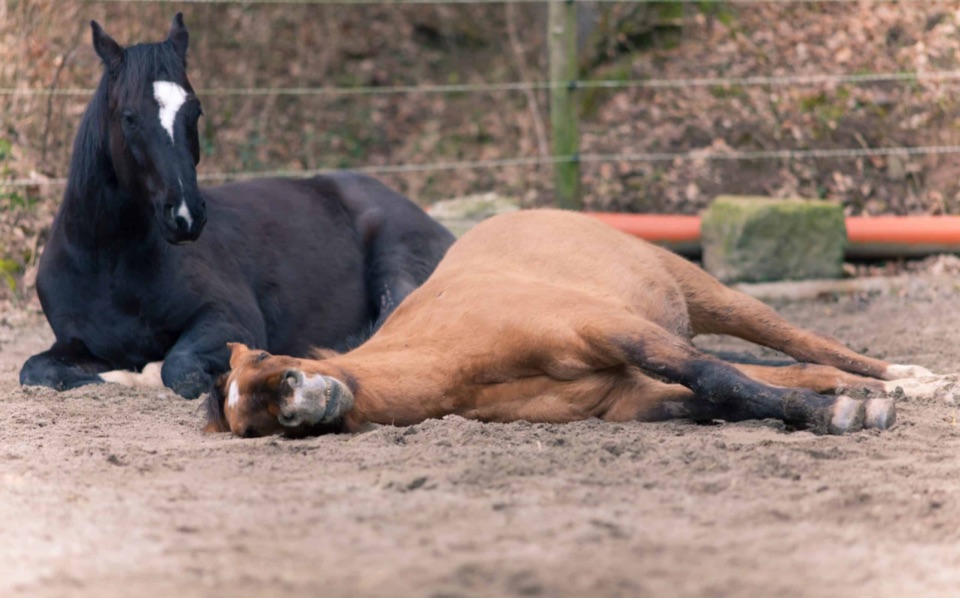
Ligger på sidan eller i flanken på mjukt strö Sträcker ut sig helt Växlar mellan stående vila och liggande vila
Äldre eller nervösa hästar kan behöva extra tid för att känna sig trygga. Tvinga aldrig en häst att lägga sig, utan skapa förutsättningar där det känns säkert.
Avslutning
God sömn är grundläggande för hästens hälsa, prestation och välbefinnande. Genom att ge en trygg miljö, konsekvent rutin, mild kroppsvård och social trygghet kan du hjälpa din häst att nå den REM-sömn som är så viktig.
En utvilad häst är en glad, frisk och samarbetsvillig partner, redo att prestera på topp och må bra både fysiskt och psykiskt.
komma ihåg du också behöver en bra natt och sova gott själva- då är partnerskapet redo för allt!
Horses are remarkable athletes and sensitive companions, but like us, their health and performance depend heavily on quality sleep. While they may nap standing during the day, achieving deep REM sleep is crucial for muscle recovery, cognitive function, and emotional balance. Without sufficient REM sleep, horses can experience poor performance, irritability, weakened immunity, and even weight loss.
So how can we, as thoughtful horse owners, help our equine friends get the rest they need?
1. Provide a Safe, Comfortable Resting Space
Horses need a sense of security to lie down and reach REM sleep. Ensure that their stall or paddock is:
Quiet and away from excessive activity Clean with soft bedding such as shavings or straw Spacious enough for your horse to stretch out comfortably
Remember, older or nervous horses may take longer to feel secure enough to lie down. Patience and a calm routine are key.
In a herd situation, some horses will choose to sleep and rest together – usually one of the herd takes the roll of guard duty for a time
2. Maintain a Consistent Routine
Horses are creatures of habit. A consistent evening routine can help signal that it’s time to relax:
Feed at roughly the same time each evening Ensure turnout or paddock access is predictable Minimize loud noises or sudden activity near their resting area
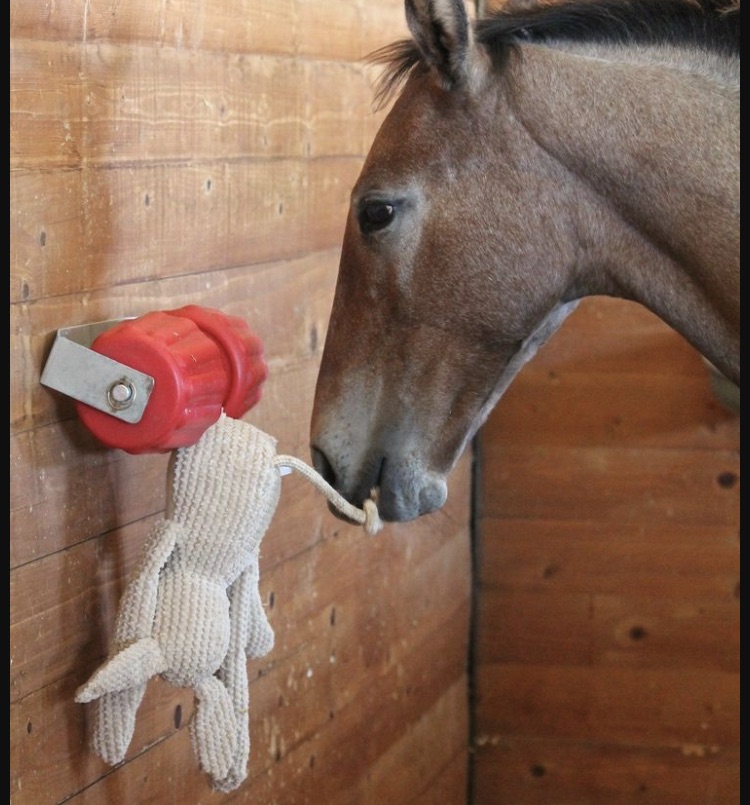
Bear in mind your routine can include certain items that make a horse feel more at home if they travel to competitions – I have one lovely dressage client whose horse has a set if cuddly teddy bears that hang in his stall for just this reason – they can be moved with him if an over night stay is required and he can feel at least a little ‘at home’
3. Encourage a Relaxed Body
Tension in muscles can prevent your horse from fully relaxing.
Gentle bodywork or light stretching before rest can make a real difference:
Massage key tension areas: neck, shoulders, and back
Encourage stretching exercises during warm-down or turnout
Calm breathing and low-light environments help signal rest
4. Allow for Social Comfort
Horses are herd animals, and many sleep better when they can see, hear, or smell a companion. If possible:
Keep them with a trusted herd mate or nearby familiar horse
Consider partial visual contact if space or resources limit full companionship
Make the bed too! Clean bedding and a deep enough underlay to be soft and safe are a vital part of the routine.
5. Monitor Light and Nighttime Conditions
Horses are naturally diurnal, and light affects melatonin production, which helps regulate sleep.
Dim lights in the stall in the evening
Reduce sudden bright lights at night
Ensure there’s enough ventilation without drafts — comfort matters
6. Observe Lying Behavior
Horses need to lie down for REM sleep, which typically lasts only a few minutes at a time but is essential.
Watch for:
Flank and side lying in safe areas
Stretching out fully on soft bedding
Alternating between standing rest and lying rest
Some horses, especially older or nervous individuals, may need more time to achieve REM sleep safely.
Never force a horse to lie down, but encourage conditions where they feel comfortable doing so.
Conclusion
Quality sleep is fundamental for your horse’s health, performance, and emotional wellbeing.
By providing a safe, calm environment, consistent routine, gentle bodywork, and social support, you can help your horse achieve the REM sleep they need.
A rested horse is a happy, healthy, and more responsive partner, ready to perform at their best while staying mentally balanced.
Remember your own sleep too – if both of you are rested, then the team is ready for anything!
De norrländska vintrarna sätter varje hästägare på prov – snö, is, fruset vatten och långa mörka dagar. Men bra hästhållning behöver inte vara dyr. Här är praktiska tips för att hålla hästarna friska, starka och bekväma hela vintern utan att spräcka budgeten.
1. Fodra för värme, inte för pengar
Hästens bästa värmekälla är grovfoder. Matsmältningen av fiber producerar mer värme än extra kraftfoder.
Ge fri tillgång på hö eller flera små höpåsar under dagen. Köp in hö i god tid innan vintern – priserna stiger när snön kommer. Lite olja eller betfor kan hjälpa hull, men undvik onödigt kraftfoder.
2. Skydd & vindstopp på enkla sätt
Hästar tål kyla bättre än vind och väta.
Bygg enkla tresidiga vindskydd med pallar, plankor eller presenning.
Om någon tänkte blir av med gammalt förråd eller liknande kan du bjuda att tar den ner och hämta sidorna samt takplåt kanske bortskänkt eller för lite pengar.
Placera skyddet bort från den vanligaste vindriktningen. Kolla den har plats och högt för dina hästar.
Håll marken torr med flis eller sand för att undvika is och lera.
3. Vatten utan el
Fruset vatten leder till kolik och uttorkning – förebygg det billigt:
Använd svarta gummikar som är lätta att slå ur isen.
Placera vatten i soliga eller skyddade lägen.
Tillsätt lite salt eller ge blötlagt foder för att öka vattenintaget.
Isolera hinkar med halmbalar eller gamla kylväskor.
4. Täcken – bara när det behövs
En frisk, oklippt häst klarar sig ofta utan täcke. Med mycket regn eller jätte blott snö är det bra att ha regn täcke. Kolla på häst loppis och secondhand på sociala medier.
Täck endast klippta, äldre eller tunna hästar.
Övertäck inte – svett kan leda till köldchock.
Håll täcken torra och laga små hål själv eller använda täcke tjänster att laga stora hål och tvätta att har lite längre hållbarhet.
5. Hov- & benvård i snö och is
Bra hovvård sparar pengar senare.
Regelbunden verkning förhindrar sprickor och snöklumpar.
Använd broddar eller barium vid ridning på is. Gummi hovboots får också har dubbar eller broddar. Rensa hovarna dagligen från is och snö.
6. Träning på vintern
Formen kan bibehållas utan ridhus.
Snö ger naturligt motstånd – skritta och trava lugnt på säkra underlag.
Gör markövningar eller tömkörning i paddock.
Korta, regelbundna pass med noggrann uppvärmning och avskrittning räcker långt.
7. Dagliga kontroller
Det bästa “verktyget” är dina händer och ögon.
Känn igenom kroppen varje dag för att upptäcka viktminskning, svullnad eller kyla.
Notera aptit, avföring och beteende – små förändringar betyder ofta något.
För en enkel ”vinterjournal” över foder, temperatur och hälsostatus.
En svensk vinter kräver planering, men belöningen är stor: en frisk, nöjd häst och en stabil ekonomi. Med grovfoder, skydd, rörelse och daglig uppmärksamhet kommer du långt – och din häst trivs i vinterkylan.
När vintern sveper in över Sverige och temperaturen kryper långt under nollan, blir det en utmaning att hålla våra tävlingshästar rena utan att riskera deras hälsa. Att duscha en häst i minusgrader är knappast ett alternativ – särskilt inte när man vill undvika stelhet, muskelspänningar eller i värsta fall köldrelaterade problem.
vinter bad kan vara en utmaning för hästägaren
Där kommer hot toweling, eller “varmhanddukstvätt”, in som ett fantastiskt och skonsamt alternativ.
🌡️ Vad är hot toweling?
Hot toweling innebär att man använder mycket varmt vatten och rena handdukar för att rengöra hästens päls, utan att blöta igenom den helt. Det är särskilt effektivt efter träning, när hästen rullat sig i boxen eller fått smuts och spillning i pälsen.
Ren handdukar med varm vatten
🧽 Så här gör du:
Förbered: Koka upp vatten eller använd riktigt varmt vatten från kranen (ca 60–70°C). Tillsätt eventuellt några droppar hästvänlig rengöring eller liniment om du vill ha extra effekt. Handdukar: Doppa en ren handduk i det heta vattnet, vrid ur noggrant (använd gärna gummihandskar). Torka: Arbeta i sektioner – torka med den heta, fuktiga handduken i små cirklar. Ångan löser upp smuts och svett. Torka torrt: Använd direkt efteråt en torr handduk för att gnugga pälsen helt torr. Skydda värmen: Lägg gärna på ett fleece- eller ulltäcke direkt efteråt så att hästen inte kyls ner, särskilt om du arbetar i ett kallt stall.
🐎 Varför fungerar det så bra?
Metoden värmer huden och musklerna lätt, samtidigt som smutsen lossnar utan att hästen blir blöt in på huden. Det är perfekt för tävlingshästar som behöver hållas rena och mjuka i musklerna – utan risk för att kylas ner.
För oss i norra Sverige, där minus 20 inte är ovanligt, är hot toweling en ovärderlig rutin mellan träning och tävling. Den håller hästen ren, varm och redo – även mitt i vintern.
I have the good fortune to know an excellent horse teeth specialist after a lifetime in the UK of fantastic tooth care from my local equine dentist.
I am consistently surprised to meet clients here in the place where I live who are unsure when their horse last had his or her teeth done! I’m not wishing to cut my work in half but, to be honest, if you have a horse with an uncomfortable mouth a body worker or rehabilitation therapist is going to have a hard time creating any lasting improvement to their movement.
So why is the state of our horses mouths so important and how does a wonky eating pattern create wonky movement?
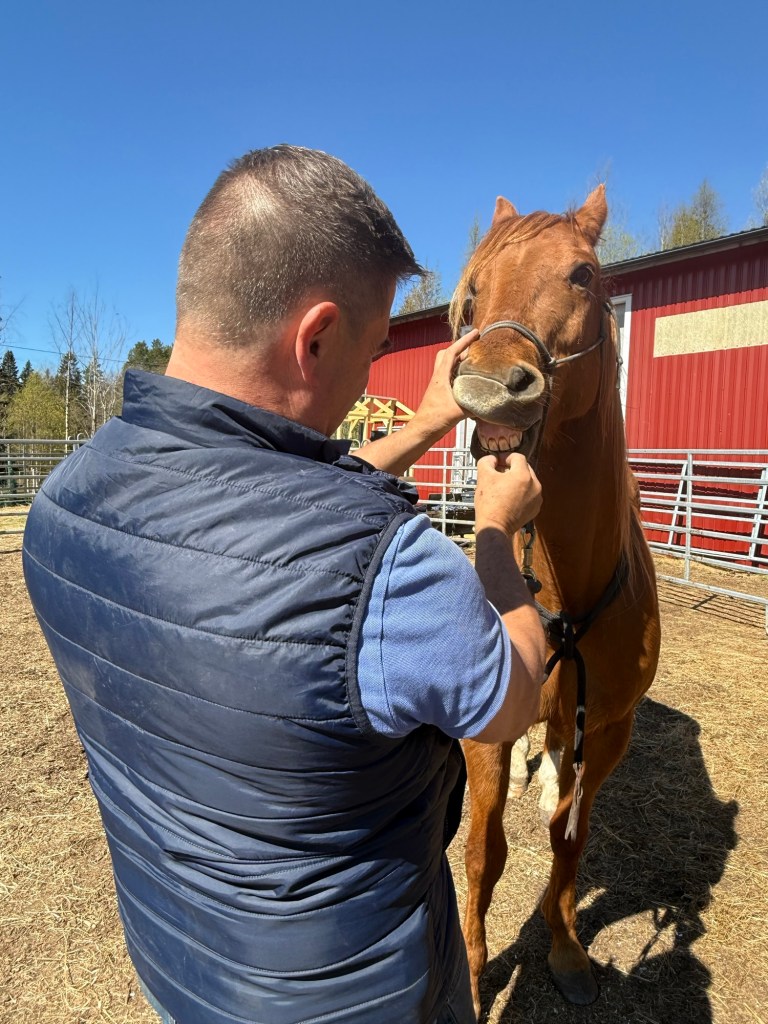
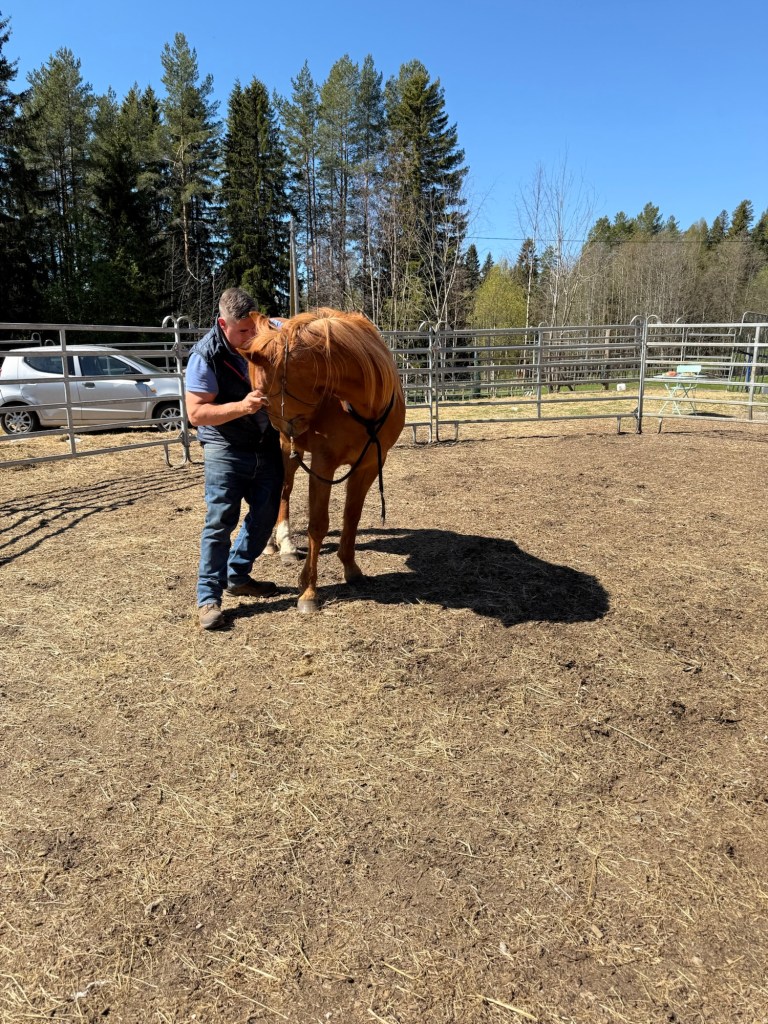
checking the incisors – no sedation- just good horsemanship with Huub Reitberg equine tooth specialist and horseman.
Regular dental check-ups are a vital yet often overlooked component of a horse’s overall health and performance. While it might not be immediately obvious, your horse’s teeth can have a significant impact on their biomechanics—particularly the movement of their hind legs.
When a horse has dental issues such as sharp points, uneven wear, or misalignments, it can cause discomfort in the mouth and jaw. This discomfort often leads to tension throughout the head and neck, which directly affects how the horse carries itself. Since the spine and muscles of the neck and back are intricately connected, tension in the front of the body can restrict flexibility and movement in the hindquarters.
We have the good fortune that our equine teeth specialist also treats the horses to cranial sacral therapy after their dentistry!
A horse in dental discomfort may resist softening at the poll, struggle with collection, or show stiffness when asked to engage their hind legs. You might notice shorter strides, reluctance to transition, or even behavioral issues under saddle. When dental problems are addressed, these restrictions often ease, allowing for better range of motion, improved balance, and more effective hind leg engagement.
Chewing on only one side of the mouth and discomfort or stiffness can lead to a lack of ability to turn a circle, a heavier feeling in one rein as compared to the other. A horse with a lack of movement in the jaw will often be unable to cross his back legs.
An equine dentist (or equine dental technician) examines and treats a horse’s mouth to ensure proper dental health. Here’s what they typically look at during an exam:
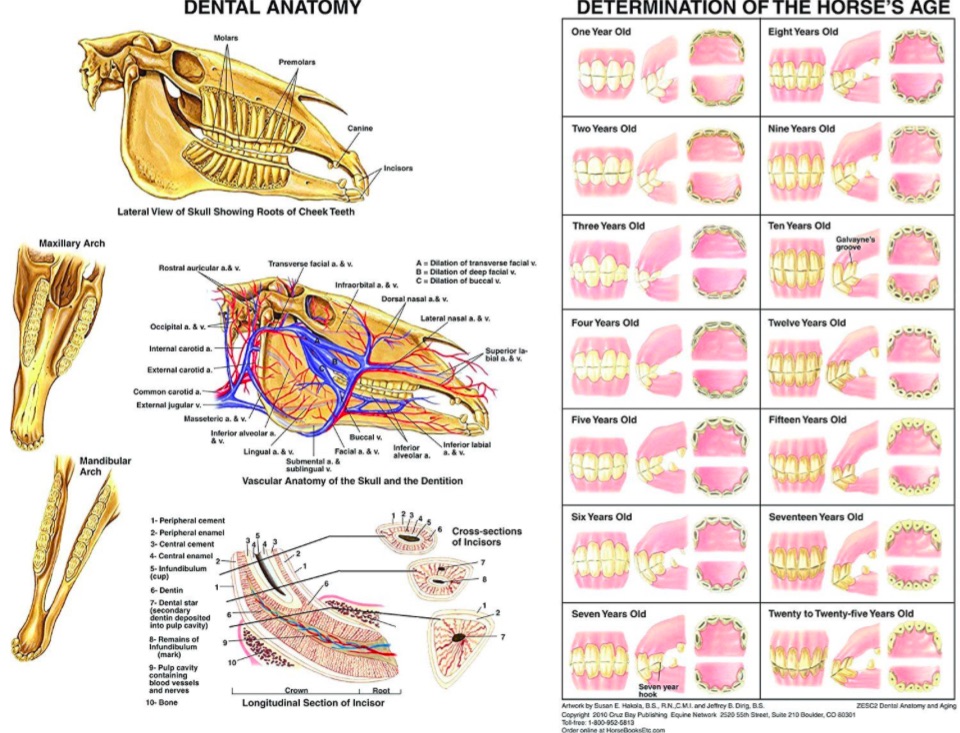
Teeth alignment and wear: They check for uneven wear, sharp points, or hooks that can cause discomfort or interfere with chewing and bit use.
Signs of pain or discomfort: They assess if the horse shows any signs of oral pain, such as dropping feed, head tossing, or resistance to the bit.
Tooth growth and development: Especially in young horses, they monitor how teeth are erupting and whether any baby teeth (caps) need to be removed.
Tooth decay or damage: They look for cracked, loose, or infected teeth.
Gum health: Checking for inflammation, abscesses, or gum disease.
Jaw alignment: They assess the movement and symmetry of the jaw, checking for TMJ issues or asymmetry.
Wolf teeth and retained caps: They may identify and remove wolf teeth if they create a problem to your horse (small, often problematic teeth in front of the molars) or retained baby teeth.
Equine dentists often use tools like speculums (to hold the mouth open), mirrors, lights, and floats (tools for filing teeth). In some areas, equine dentistry is performed by veterinarians; in others, trained technicians specialise just in the equine head and neck so that the service they provide is comprehensive.
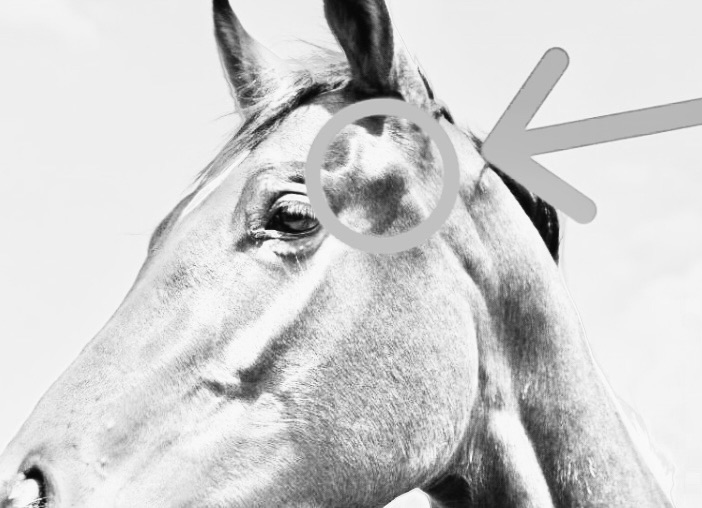
The temporomandibular joint (TMJ) in horses—located between the mandible (lower jaw) and the temporal bone of the skull—is a crucial but often overlooked component in overall equine biomechanics.
Locating the TMJ.
TOP TIP; Gently stroking your horse in this region can be extremely soothing
When there’s dysfunction or pain in the TMJ, it can affect the entire body and movement of the horse. Here’s how:
Impact on Head and Neck Posture TMJ discomfort can cause a horse to carry its head awkwardly or resist rein contact. This altered head and neck carriage affects the balance and alignment of the spine, influencing how the horse uses its back and hindquarters.
Influence on Bit Acceptance and Performance The TMJ is closely connected to the tongue, hyoid apparatus, and muscles of the throat. If the TMJ is sore, a horse might resist the bit, show tension in the poll, and struggle with lateral flexion or collection.
Muscular Compensation and Asymmetry Pain or restriction in the TMJ can cause muscle tension patterns throughout the neck, shoulders, and back as the horse compensates. Over time, this can lead to uneven gaits, stiffness, and reduced range of motion.
Connection to the Spine and Pelvis The horse’s body works as a kinetic chain. If one link (like the TMJ) is off, it can affect the entire chain, from the poll to the pelvis. TMJ tension can cause the horse to brace through the topline, affecting hind limb engagement and leading to inefficient or unbalanced movement.
Nervous System Involvement The TMJ is richly innervated, especially by the trigeminal nerve, which also connects to facial muscles and contributes to proprioception. Dysfunction can lead to neuromuscular imbalances, behavioral changes, and even signs of pain elsewhere (referred pain). Summary: A dysfunctional TMJ in a horse can lead to head tossing, uneven gaits, poor bit acceptance, tension in the neck and back, and compromised performance. Proper evaluation and treatment—often involving dental care, bodywork, and sometimes chiropractic or craniosacral therapy—can greatly improve overall movement and comfort.
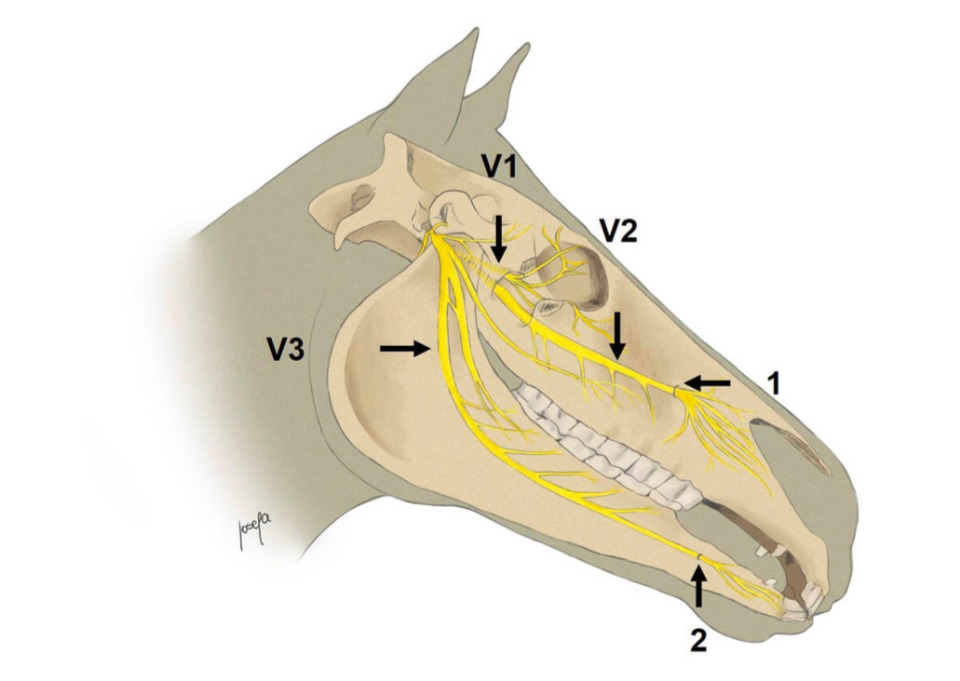
The facial nerves can be affected by dental misalignment and are a group of three nerves essential to your horse known as the Trigeminal Nerve.
The equine trigeminal nerve is the fifth cranial nerve (CN V) in horses and is primarily responsible for sensation in the face and motor functions related to chewing. It has three major branches:
Ophthalmic branch – provides sensory input from the forehead, eyelids, and eyes.
Maxillary branch – carries sensation from the upper jaw, teeth, nose, and part of the face.
Mandibular branch – provides sensory input from the lower jaw and motor innervation to the muscles of mastication (chewing).
Functions of the Trigeminal Nerve in Horses:
Sensory: Detects touch, pain, temperature, and proprioception in the face, teeth, sinuses, and parts of the oral cavity.
Motor: Controls the muscles involved in chewing.
Problems Caused by Damage to the Trigeminal Nerve:
Trigeminal Neuralgia (commonly suspected in “headshaking syndrome”):
Horses exhibit spontaneous, often violent head shaking or flicking.
May be seasonal or triggered by light, wind, or exercise.
Often considered a neuropathic pain condition, potentially involving hypersensitivity of the trigeminal nerve.
Loss of Sensation:
Numbness in areas innervated by the affected branch.
Can lead to unnoticed injuries or ulcers, particularly around the eyes or mouth.
Motor Deficits:
Difficulty chewing or asymmetrical jaw movement.
Muscle atrophy on one side of the face if the mandibular branch is affected.
Other Clinical Signs:
Drooping of the face or eyelids (if multiple cranial nerves are affected).
Abnormal facial expressions or difficulty eating.
Head shaking syndrome occurs with trigeminal nerve damage.
Diagnosis and Management of Head Shaking:
Diagnosis often involves ruling out other causes (dental, sinus, neurological) and sometimes includes nerve blocks or imaging (MRI/CT).
Treatment can be difficult, especially for trigeminal-mediated headshaking:
Medical management: anti-inflammatories, anti-convulsants (e.g., gabapentin), or cyproheptadine.
Surgical options: nerve root compression or neuromodulation (e.g., PENS therapy).
Management strategies: fly masks, nose nets, or changing exercise patterns.
In short, regular dental exams don’t just protect your horse’s mouth—they can play a key role in freeing up their entire body. By ensuring their teeth are healthy and pain-free, you support more fluid movement and a more comfortable, responsive ride.
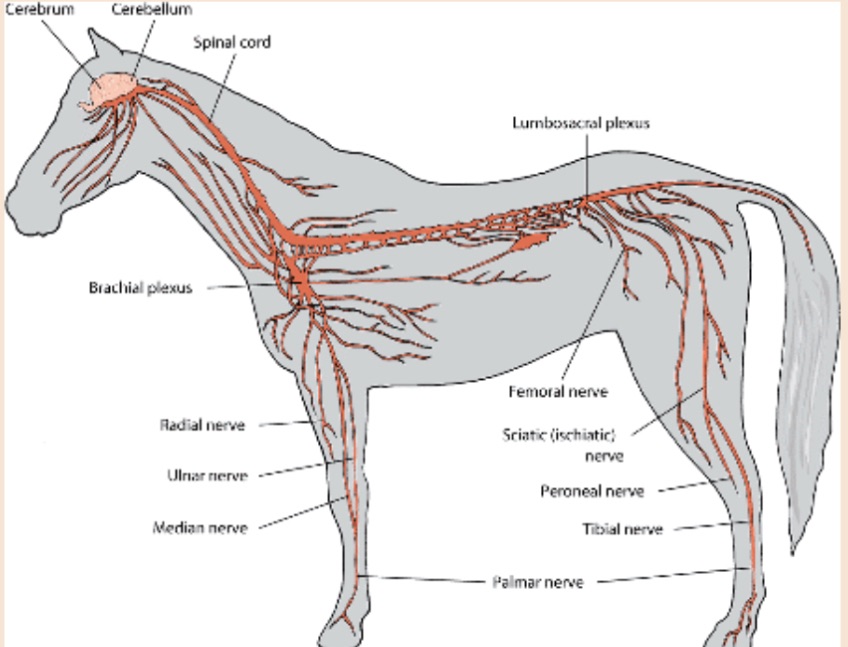
The horse’s body is a whole structure with nerves permeating throughout and fascia providing pathways for pain and proprioception. If one area is misaligned, uncomfortable or over stressed, the whole body will be affected
here is teddy (back right) teaching Waylan (front left) how things work around our horse farm – size doesn’t matter in the horse world but energy, wisdom and presence does!
When we do this, we remove them from an environment and set of routines they have become familiar with, and put them somewhere completely different with new people, new horses and different ways of doing things.
When we think of how horses learn and process information and when we study the neuroscience, we realise this causes enormous stresses to the horse.
Why does she call it a syndrome?
A syndrome is a term used to describe a set of symptoms that consistently occur together and can be tied to certain factors such as infections, genetic predispositions, conditions, or environmental influences. It is also used when the exact cause of the symptoms is not fully understood or when it is not connected with a well-defined disease. In this case, “New Home Syndrome” is connected to a horse being placed in a new home where its entire world changes, leading to psychological and physiological impacts. While it might be transient, the resulting effects in the horse can be significant for both that horse and anyone handling or riding it.
Dr Shelly explains this way;
‘Think about how good it feels to get home after a busy day. How comfortable your favourite clothes are, how well you sleep in your own bed compared to a strange bed, and how you can really relax at home. This is because home is safe and familiar. At home, the part of you that keeps an eye out for potential danger turns down to a low setting. It does this because home is your safe place (and if it is not, this blog will also explain why a lack of a safe place is detrimental).’
Therefore, the first symptom of horses experiencing “New Home Syndrome” is being unsettled, prone to anxiety, or difficult behaviour.
If you have owned them before you moved them, you can struggle to recognise your horse, feeling as if your horse has been replaced by a frustrating version. If the horse is new to you, you might wonder if you were conned, if the horse was drugged when you rode it, or if you were lied to about the horse’s true nature.
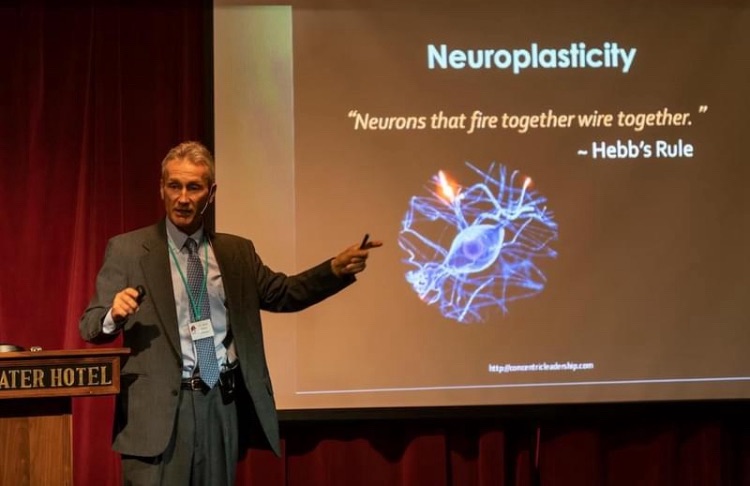
Horses have amazing abilities to adapt and cope. They have a neuroplasticity which means that they can learn new things but we have to be careful that we do not over stimulate them with a hundred new things at a time. Moving a young horse to a new farm and then taking your first riding lesson on them a couple of days later is like taking a toddler to a new day care and asking them to do a complicated math sum a couple of days later.
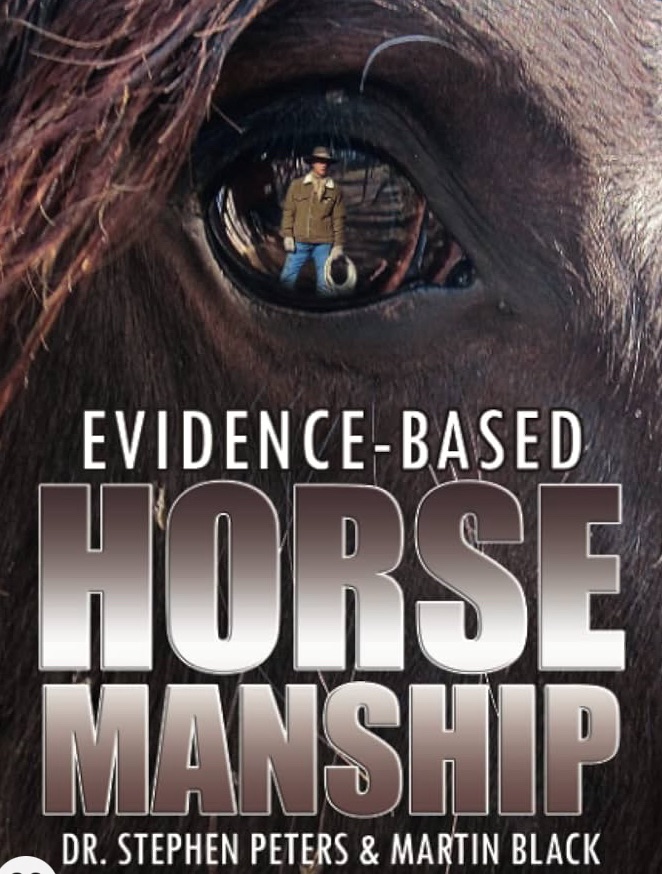
i love the work of Dr Steve Peters who is a neuroscientist and explains the horses brain in ways that help horse owners understand how best to cooperate with and train their own horses.
One of the best things that Dr. Steve Peters does in his webinars and workshops is taking the time to explain the types of information we are exposed to… Anecdotes, expert opinion, research papers (the actual scientific paper submitted not articles about them written by journalists), case studies, peer reviewed, etc. and he also explains the science of personal biases (we all have them) and cognitive dissonance. Being aware of all of these things helps us all be better learners and ultimately better partners for our horses!
stressed on first arrival, there were a few habits from his previous home i tried to incorporate – same food; company of a human while eating; a friendly pony or two in the next field to get to know, but i doubt Waylan slept much in his first few days here at the farm.
A horse with “New Home Syndrome” will be a stressed version of itself, on high alert, with a drastically reduced ability to cope.
Horses don’t handle change like humans do. If you appreciate the comfort of your own home and how you can relax there, you should be able to understand what the horse is experiencing. But it is even more for the horse because they have sensory systems set up to alert and warn them of any new visual or movement patterns. Even your super calm cold blood will feel this uncomfortable over-alertness though they may not show it as much. Research shows their heart rates and cortisol levels can be as high or even higher than that dancing english fullblood in the next stall!
Respecting that horses interpret and process their environments differently from us helps in understanding why your horse is not behaving like you are used to him behaving or recognising that there is a good chance you were not lied to or that the horse was not drugged.
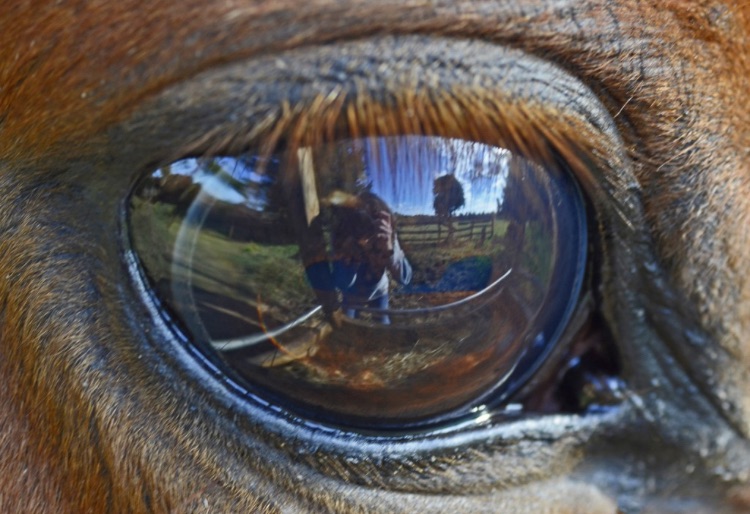
…..how we sense the world and how they do is different but are we aware of just how different?
Horses have survived through evolution by being highly aware of their environments. Change is a significant challenge for them because they notice the slightest differences, not just visually but also through sound, smell, feel, and other senses.
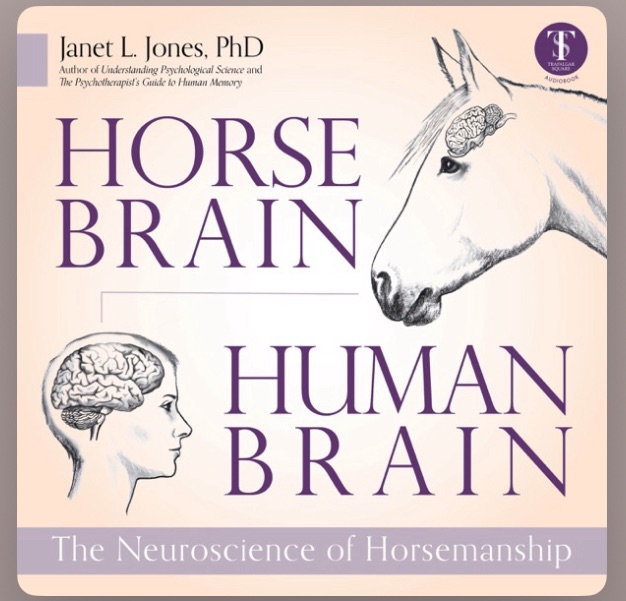
In her book, ‘Horse brain, Human brain,’ Dr Janet Jones explains how our thinking patterns and those of the horses differ; Humans generalise and categorise, making it easy for us to navigate familiar environments like shopping centres. She gives the example of a hose hung in the back door of the stables. we categorise it as ‘hose’ but if that hose is hung a little differently or the light catches it in a different way, the horse sees all the different shapes and shadows and takes in the details we ignore.
another good read!
Horses do not generalise in the same way; everything new is different to them, and they need proof of safety before they can get used to an environment and feel secure. This has been essential to 55+million years on our planet, making equus caballus (our pretty ponies) actually an extremely successful species!
When their entire world changes, it is deeply stressful for a horse.
They struggle to sleep until they feel safe, leading to sleep deprivation and increased difficulty.
But there is more…
Even we humans tend towards similar routines and patterns of behaviour (it is the reason taking up a new health routine or breaking a habit like snus can be really tough)!
So, back to our horses. Not only are they confronted with the challenge of figuring out whether they are safe in all aspects of their new home while being sleep deprived, but every single routine and encounter is different.
Then, their human or new human owner starts getting critical and concerned because the horse suddenly seems untrained or difficult. The horse they thought they owned or bought is not meeting their expectations, leading to conflict, resistance, explosiveness, hypersensitivity, and frustration.
The horse acts as if it has forgotten all its training because it is stressed and because the routines and habits it has learned have disappeared.
If you are a new human for the horse, you feel, move, and communicate differently from what it is used to. The way you hold the reins, your body movements in the saddle, the position of your leg – every single routine of communication between horse and person is now different.
thanks to John Warburton, wild-place and wild- animal ambassador, for this lovely photograph of me and my herd organiser, Callum
When you get a new horse, you have to introduce and teach your way of communicating to the horse. You have to introduce yourself and take the time to spell out your cues so that they get to know you. Actually we want at least as close a relationship with our horses as we do with human friends and family members. This half ton of scared rabbit is after all in part responsible for your safety while flying fences and galloping in the forest!
Add into the mix a new herd.
Some people find it easy to move, making friends and social contacts easily, while others have to work at joining a group. it is the same with our horses. Well maybe more so….
Search on youtube for wild horse videos and you soon find films of young males attempting to join groups and failing or succeeding but at a cost.
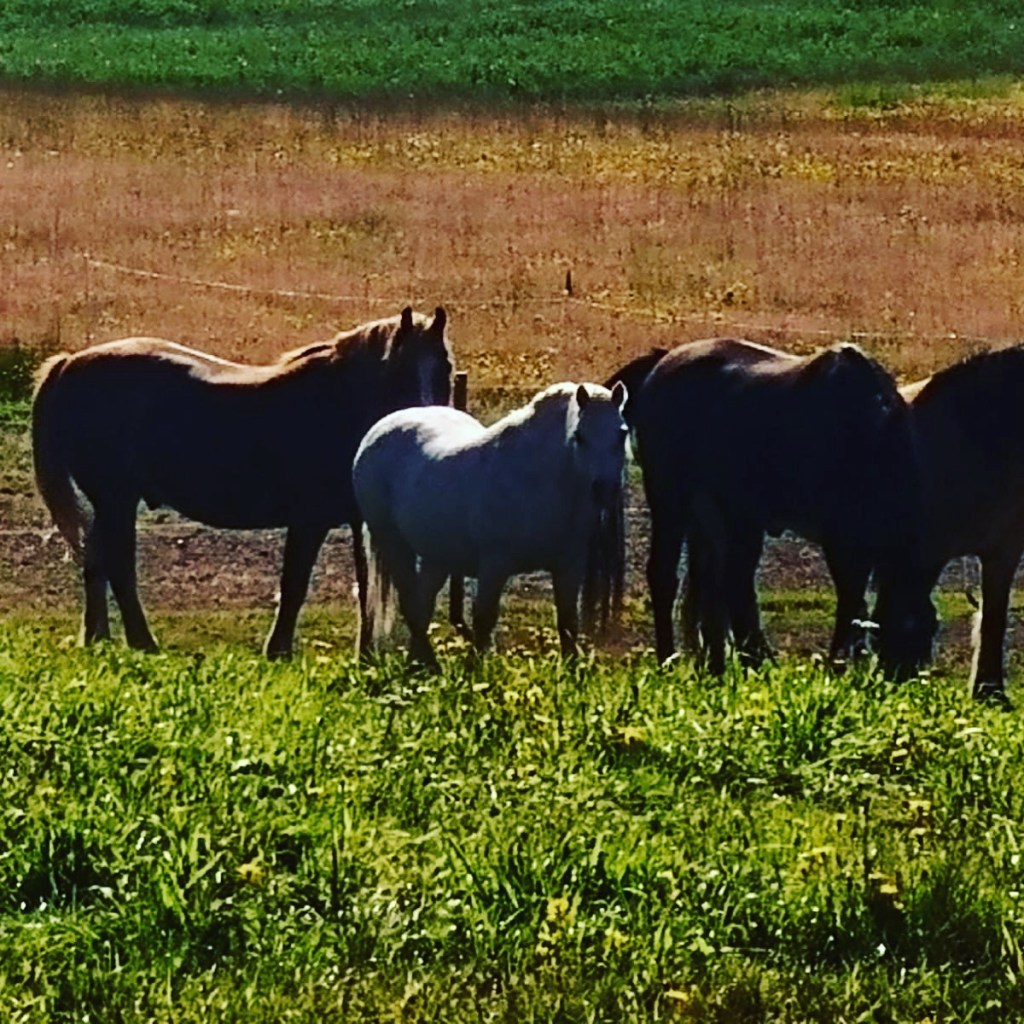
my gang
Even though we may have removed the ability of gelding horses to procreate, we haven’t removed the herd instincts and geldings can seek to mate with mares and dominate each other in similar patterns to stallions. Mares can chase away ‘threats’ to their ability to create more healthy herd members and do all the behaviours of their wild sisters.
So a process of forming a new herd (even if they only join one or two others) is an essential part of the social life of your horse. And depending on the stable you move your horse to, this can be well managed or not. Ultimately it is a further stressor for your horse.
Therefore, when you move a horse to a new home or get a new horse, your horse will go through a phase “New Home Syndrome,” and it will be significant for them.
Understanding this helps them get through it because they are incredible and can succeed.
The more you think about these factors and help the horse learn it is safe in its new environment and navigate the new routines and habits you introduce, the faster “New Home Syndrome” will pass.
The alertness and fearful behaviours will be prevalent in a horse’s life until they have learned to trust the safety of the environment (and all that entails) and the humans and other animals (I include dogs barn cats, sheep, cows and chicken in this) they meet and interact with.
With strategic and understanding approaches, this may take weeks, and their nervous systems will start downgrading their high alert status. However, for some horses, it can take a couple of years to fully feel at ease in their new home, especially where changes have been numerous or traumatic in the past. When we took in rehab horses in the past, we gave them two years before we ever began to feel we truly knew them. That doesn’t mean two years of doing nothing, but rather two years of being careful to keep things as regular and routine as possible…. familiar routines for food, friends and humans so that working and learning was easier as the stressors were reduced.
sometimes a familiar friend can make a long move or journey feel ok
So, next time you move your horse or acquire a new horse and it starts behaving erratically or being difficult, it is not being “stupid”, you might not have been lied to or the horse “drugged” – your horse is just experiencing an episode of understandable “New Home Syndrome.”
I love this phrase and name for what I have seen so often and heard from customers over the years.
With thanks to the neuroscience and research work of Dr Steve Peters, Dr Janet Jones and Dr Shelly Appleton as well my old boy Luke, a red coloured horse who patiently started my journey into the science and art of cooperating with horses.
Djupa skador på digitala böjsenor (DDFT) är en vanlig typ av senskada som uppstår hos prestationshästar. Hästens DDFT ger stöd till kotleden, fungerar som en fjäder som lagrar energi vid rörelse och stabiliserar benet under full viktbärande belastning.
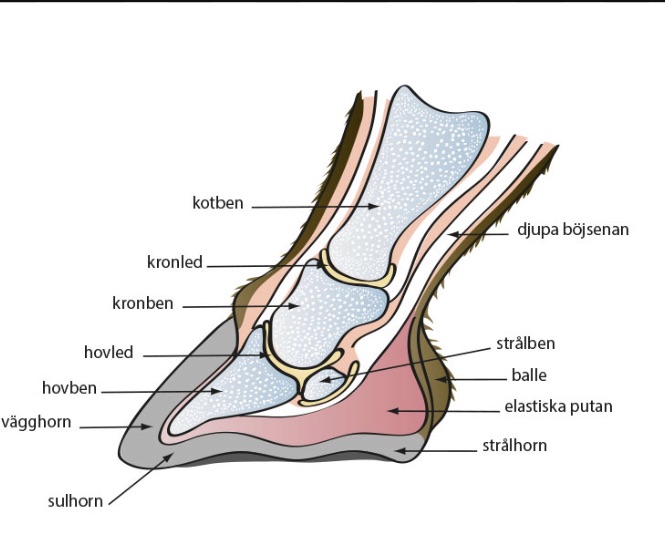
Fot insidan!
DDFT finns i hästens fram- och bakben.
I frambenen kommer den från tre olika platser — överarmsbenet, armbågsbenet och strålbenet — där den löper längs baksidan av hästens ben, ner i handlovskanalen på baksidan av knäet och genom senskidan på baksidan av kotan; vid denna punkt är där den vidgas och blir platt, korsar över navikulärt ben, går ner i foten och fäster på baksidan av hovbenet, där den löper inom den ytliga digitala böjsenan (SDFT) och omedelbart över det suspensiva ligamentet. I hästens bakben börjar DDFT från två olika platser vid skenbenet, där det löper ner och in i hovbenet.
DDFT-skador beskrivs enligt skadans placering och utseende —som endast kan diagnostiseras med hjälp av ultraljud, MRT eller tenoskopi — ses vanligtvis i kroppen eller gränserna för senan som förstoringar, fokala kärnskador, mineraliseringar, formförändringar och marginella tårar. De vanligaste DDFT-skadorna hos hästar är i bakbenen, vid senskidan eller i hovkapseln.
Skador på specifika områden av DDFT ses ofta i samband med hästens primära atletiska aktivitet. Till exempel förekommer DDFT-skador i frambenen oftare i den karled regionen hos endurance/långdistans-, polo- och barrel låg nivå hopp hästar. DDFT-skador förekommer oftast i fotregionen i frambenen och bakbenen hos medelålders dressyr eller hopp hästar. Men den kan hända genom alla ålder och jobb och speciellt när underlaget är halkigt eller tungt.
Så vad kan vi som ägare och fysio göra i teamet med veterinär?
Photo by Fallgregg
Vissa terapier är regelbundet rådat och vissa kan funka bra; fråga din equiterapeut eller Fysio och se till att hovslagare, equiterapeut och veterinär har kontakt med dig och din häst och information om varandras behandling.
Som vid de flesta mjukdelsskador är grunden för behandling av DDFT-skador vila och rehabilitering. Långa perioder av rehabilitering är nödvändiga, ofta upp till ett år, bestående av vila följt av ett långsamt stigande träningsprogram.
Forskning tyder på bättre resultat när råd från equiterapeut och veterinärer följs och med hjälp av fysioterapi/equiterapi från början. Forskning tyder också på att hovvinkel och hovstöd genom trimning, stöd till den bakre delen av hoven vid skoning (eller applicering av gummistövlar på barfotahästen) kan vara en viktig del av rehabiliteringen.
Förlängd stallvila och kontrollerat träningsprogram
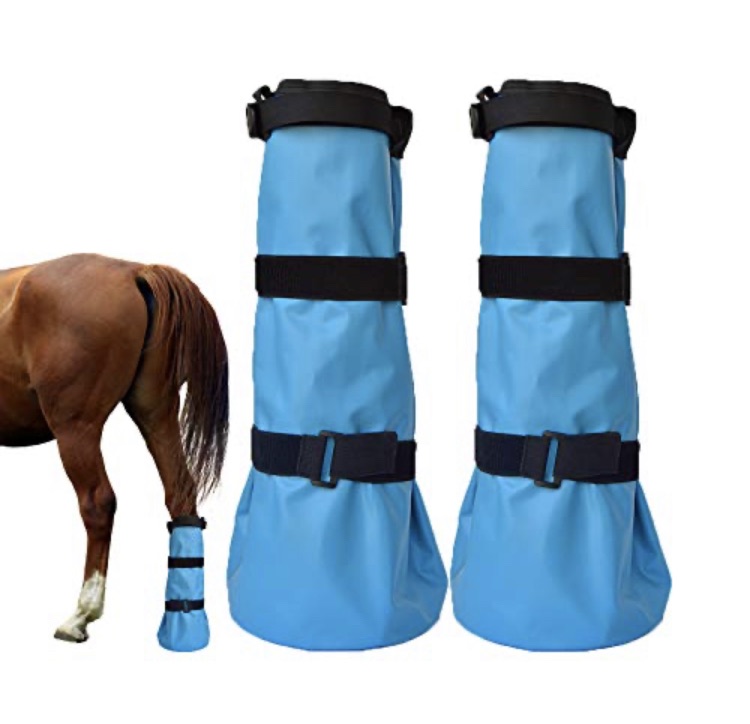
Is /kylande terapi – om du har ingen sån boots du kan göra liknande med en hink fyllde med is eller ett barns vinter overalls med botten ihopsydda då fyllde med is (eller snö i vinter)!
Fylla boots med snö eller is även kalt vatten
Löpband med vatten – vattentrask
Intrasynovial administrering av kortikosteroider och natriumhyaluronan av veterinär
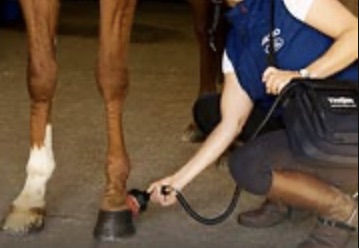
Radiovågsterapi Behandling av DDFT-skador med INDIBA eller radiovågsterapi Radiovågsterapi är fantastiskt för behandling av senskador genom att ge en biostimuleringseffekt vid en exakt frekvens på 448 kHz, vilket främjar: 1.Ökad cellmetabolism 2. Ökat blodflöde och därmed syresättning 3. Minskad inflammation 4.Smärtstillande effekt 5.Främjande av cirkulation 6.kan påverka djup i kroppen
Hur radiovågs terapin kan behandla på ett ben
Terapeutiskt ultraljud har en liknande effekt men tar längre och mera behandlingar för effekter att börja
Laserterapi genom utbildat personal kan vara suverän för både inflammation minskning samt kompensations belastningens behandling. Laserterapin ökar cellmetabolism; 1. Antiinflammatoriska effekter 2. Ökar cirkulationen 3. Minskar smärta
Hos Fyra Fötter använder vi Thor animal laser som har lång erfarenhet och mycket forskning bakom märken.
Trombocytrik plasma (PRP) Stamcellsterapi behandling av veterinär
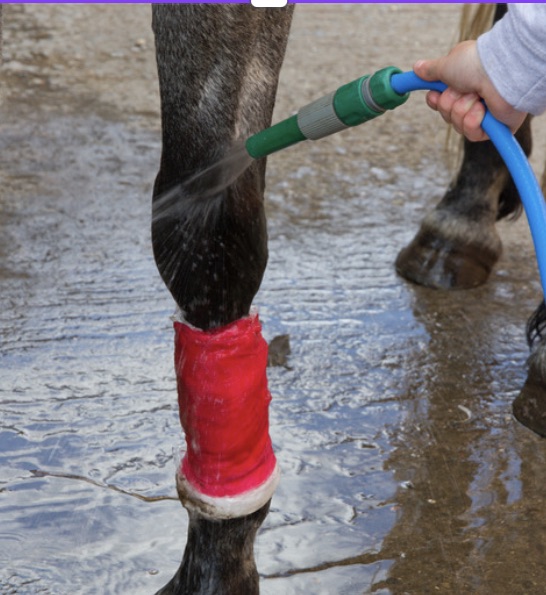
Stöd bandage Zinkabandage tex kan påskynda läkning av flera typer av skador som exempelvis, senskador, överben, gallor, benhinnereaktioner samt svullnader.Lindan kan appliceras direkt på hud, päls och sår. Kan sitta upp till 7 dagar. Det är viktigt att lindan inte dras åt för hårt! Bandaget ska lindas på med en överlappning på 50%, det får inte bli glipor i lindningen. När den torkat bildar den ett halvstelt förband. (Det kan finnas zinkbandage hos apoteket för litet billigare pris än vissa hästföretag)
Bandaget ska skyddas med exempelvis flex wrap. Om bandaget lossnar måste det läggas ett nytt.
Kinesiotejpning – vi har sett bra resultat från kinesiotejpning både genom läkning och efter i rehabiliterings övningar. Det är en terapeutisk tejp som används för att stödja muskler och leder och hjälpa till att minska smärta. Det används ofta av atletiska tränare, idrottare och sjukgymnaster inom människans träning och terapi men det har nu blivit ett beprövat system för stöd, lymfrörelser, fasciastimulering, remodellering av ben och ligament i hästveterinärvärlden efter dess tidiga introduktion till galopplopp och fullblodshästavel. Tejpen kan: 1.Minska eller lindra smärta 2.Öka blodflödet 3.Minska svullnad 4.Minska inflammation 5.Andra påståenden om muskelaktivering, cirkulations- och proprioceptiva mekanismer. Hos Fyra Fötter är vi utbildat och vi har erfarenhet av att använda kinesiologi tejp för olika skador, träningsvärk och träning.
Pulserande elektromagnetisk fältterapi
Värme och is
Om du kan, ’cold hosing’ över en bandage med bomullstyg är en bra termoterapi och håller kylan längre än bara på benet
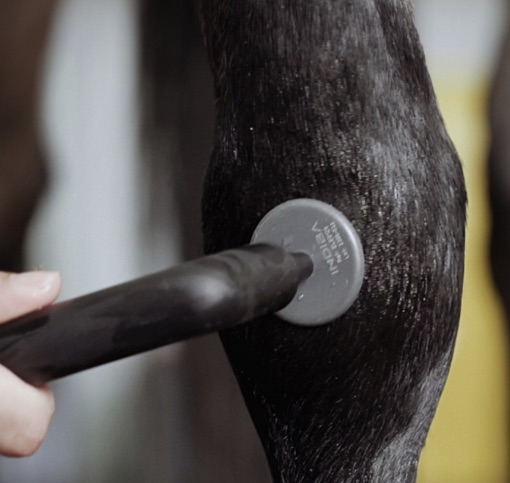
Is och vibrationer
I Fyra Fötter har vi icevibe boots att hyra
Stötvågs behandling – det finns vissa terapeuter som älskar stötvåg för att den minskar signaler i hästens nervös systemet av smärta och ont, men den kan vara kontraproduktiv var man vill också hästen undvika över belasta benet så för oss är juryn ut på den!
Massage – Forskning stöder de positiva effekterna av massage på muskeltonus och cirkulation, vilket är viktigt för hästidrottare. Förbättrad cirkulation underlättar effektiv syre- och näringstillförsel, påskyndar återhämtningen och ökar uthålligheten.
Lymfmassage – 1.Förbättrad immunfunktion 2.Ta bort överflödig vätska 3. Ta bort gifter, avfall, bakterier och virus från kroppen 4.Förbättrade energinivåer 5.Smärtlindring och/eller förbättring av den allmänna komfortnivån
Behandling av kompensions obekvämheten innan dem blir permanenta i rörelsemönster – Vi I Fyra Fötter litar på forskning om kompensations rörelser och hur dem påverkar framtidens hälsa, friskvård och rehabilitering så är det en stor del av våran behandling som fokuserar på hela hästen
Efter den akuta perioden och när svullnaden minskar;
Öka arbetsbelastningen gradvis snarare än plötsligt.
Regelbunden planering av skoning för att undvika lång tå, låg klackkonfiguration
Tidig upptäckt och behandling av annan hälta för att förhindra kompensatorisk senöverbelastning
Nu…..
Tyvärr, rehab en mjukdelsskada hos en häst, det ser ut ungefär så här:
Lindra, stallvila, is/kall slang, handbete. Försök desperat att underhålla en 600kg småbarn. Försök försiktigt, med många desperata böner, att starta veterinärens rekommenderade partiella utvisning eller så småningom markera arbet eller under sadelarbete. Överväg lugnande medel (mest för att du ska förhindra hyperventilering första gången de skjuter och lyckas galoppera i den trestegspenna som du hoppades skulle förhindra sådan galenskap). Känn hur ditt hjärta faller ner i tårna när det skadade benet slumpmässigt sväller precis tillräckligt för att övertyga dig om att det är det här, allt är förgäves och livet är över. Fira när de fortfarande är friska och svullnaden försvinner (eller gråt när en annan veterinär/fysio/hovslagare näbb läggs till i ekvationen). Gå, gå och gå lite till. Testa 22 olika tidtagningsappar medan du försöker trava exakt 7 minuter. Håll tummarna varje dag så att stegen är jämna. Undersök PRP, Shockwave, aquatread, voodoo, magnawave, massage, djurkommunikatörer och sjögräs för att se om det finns en sak till som kan göra skillnaden. Hoppas, förtvivlan och hoppas lite mer. Och precis när du tror att det är dags att ta upp smörgåsar med hästkött, ser din älskade fyrhuvade vän lite bättre ut, sedan mer och mer.
Jag skojar en lite här men poängen är att det här inte är en snabb eller garanterad väg tillbaka till hälsan – för att ta väganalogin lite för långt – det finns tillfällen då det kommer att verka som en av de där skogsstigarna som gjordes för skogsbilar för flera år sedan och bara tar slut så du måste gå tillbaka där du var.
Och mitt råd? Hitta ett bra team och få dem runt dig och gör rehabben – jag har sett hästar avsluta sina karriärer på grund av detta men jag har sett minst lika många gå tillbaka till tävlingen.
Och i alla fall…din häst är mer än bara en maskin, eller hur?
Om du bara ägnade dig åt tävlingen hade du förmodligen köpt en mountainbike!
I min personliga och professionella erfarenhet av den här typen av skada har du chansen att bygga en relation – ett partnerskap som kommer att vara längre än all sorg inför nästa tävling du kommer att missa…
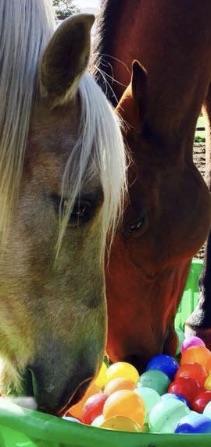
Förslag om vad man göra genom stall vila tiden:
Håll din häst sysselsatt under stallvila. Se till att de har sällskap.
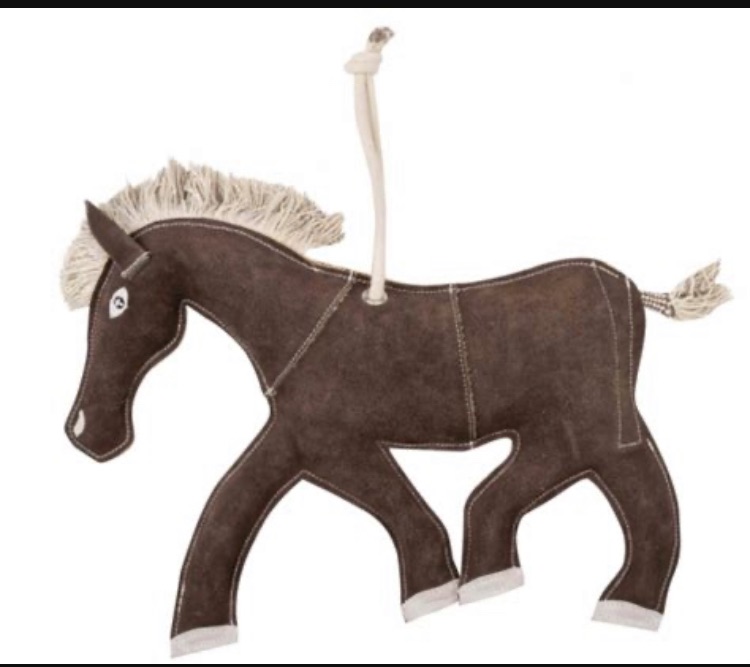
En nallebjörn ger hästen nånting att bufflar på och pysslar med
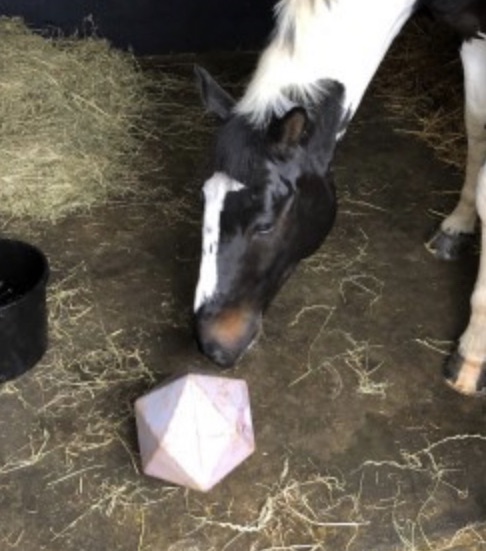
Tillhandahåll leksaker eller godsaker som de måste fungera för att få.
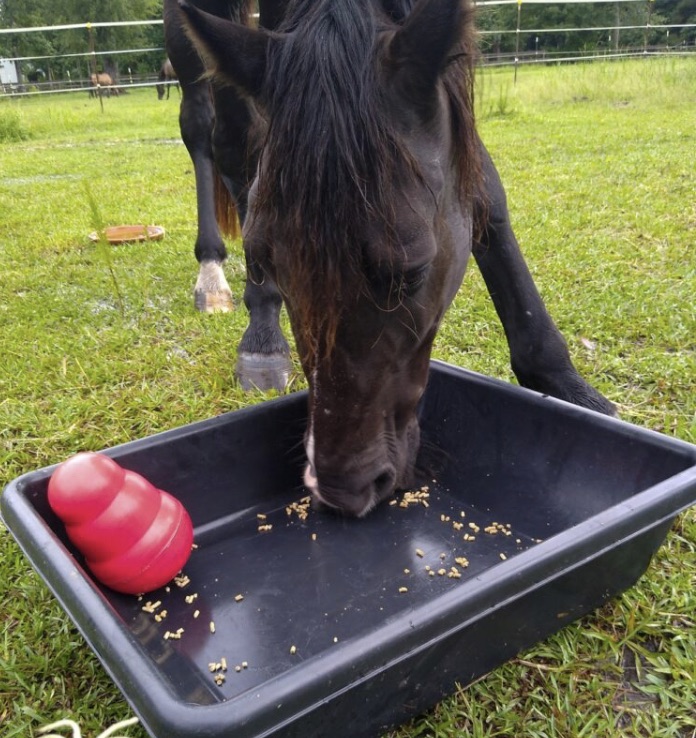
Kong med mineraler i en låda tar lite längre att äta
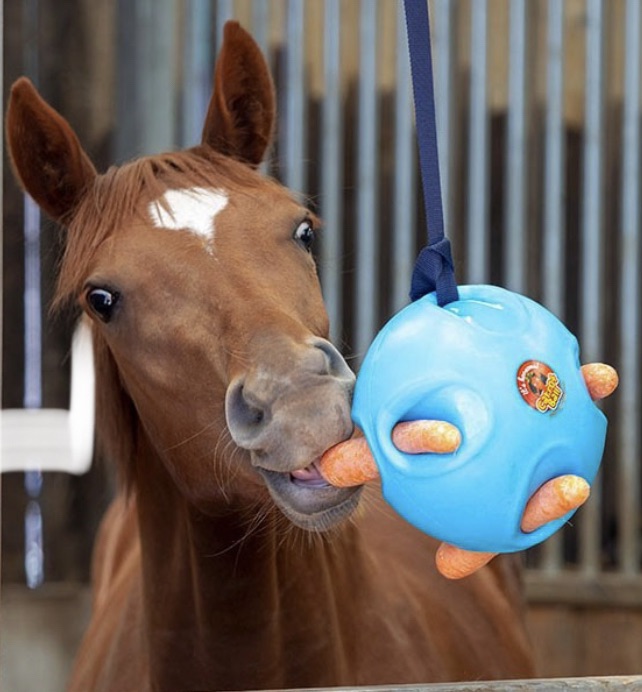
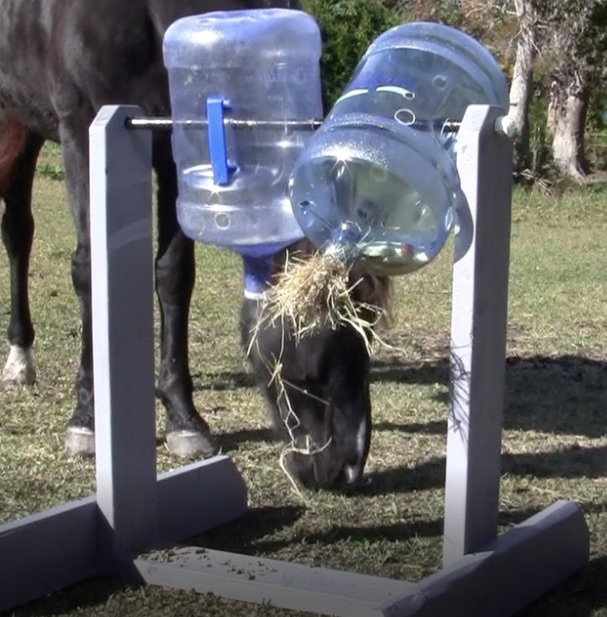
Ge tillgång till moget gräshö under större delen av dagen. Lägga den i olika höjder och olika typ av påsar- tex nätt, på jorden, i en hö påse, i en höboll med hål. Du kan också gömma några godis som morot strimlor eller testa andra som kålrot, äpple, banan eller orange.
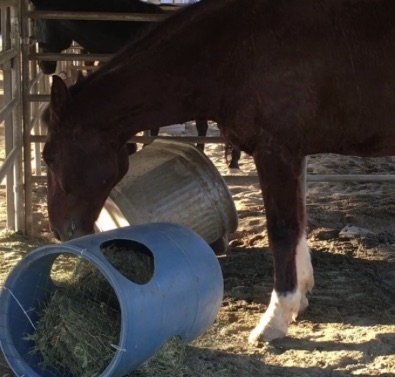
Hål i en tunna – då måste man rulla liten med måsen att få ut hö
Pepparmynta olja i vattnet kan stimulera hjärnan så hästen känner sig mer trygg.
Eteriska oljor som rosa kan hjälpa om hästen är stressig eller oroa sig. Prova på liten saft i en extra vatten hink för intresse.
Tar en bok eller telefon med dig och utemöbler och hänga med din häst.
Små del hö
Borsta hästen och göra som du brukar göra med man och svans.
Godis boll
Göra nosework i boxen med din häst (fråga oss om en kort kurs inom nosework med hästar – så kul)
Söka godis i en boll hav
Handpromenera eller handbeta din häst ofta. Om hundpromenad är förbjudet, då kan du såg trädgrenar från ogiftiga träd och hämta in salad från marken för din fyrbenta vän.
Spinna flaskan att få ut hö eller godis
Stretcha din häst med råd från din veterinärrehabiliteringsterapeut/equiterapeut – morot eller clicker mål stretch kan vara bra mot kompensations belastningar samt kan vara en bra partnerskap aktivitet
Godis leksak när du stor med hästen kan känna så mysigt
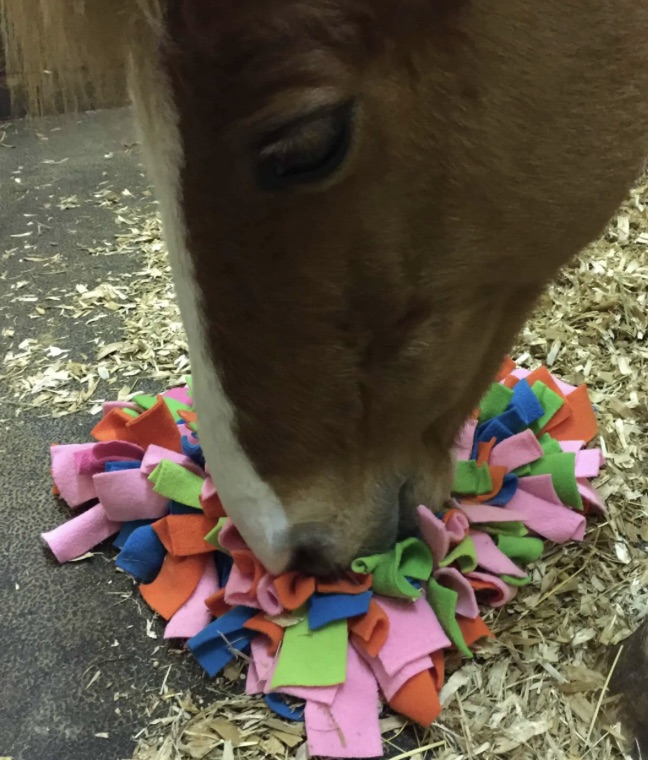
Använda snuffel matt lika den som man har till hundar och gömma godis eller frukt/rotfrukter
Se till att begränsa riskerna för återskador när du återgår till valdeltagande.
Många hästar njuta av extra saker i stallet att pyssla med – är inte skett själv den gossedjur känner precis så nöjd som hästen! 😂
Sätt tillbaka din häst långsamt till jobbet med vägledning av dit veterinärrehabiliteringsterapi team.
Hoppas det här är hjälpsam till dig som har en senskadat häst (eller kanske också en häst som behöver rehabilitering för nån annan sak)!
Tar tiden också för dig i den här process. Tar behandling själv – nu är kanske en bra tid att börja den yoga klass du önskat och läsa den bok (kanske om häst hantering eller träning) som har suttit på hyllan för ett tag.
Vi hos Fyra Fötter är här för råd, behandling och stöd genom den här rehabiliterings process.
One of the significant challenges facing horse owners today is the rising cost of horse care and ownership. Maintaining a horse involves various expenses, including feed, veterinary care, farrier services, equipment, and boarding or stable fees. The cost of hay, grains, supplements, and medical treatments can be substantial, making it challenging for horse owners to provide the necessary care while managing their budget.
Additionally, economic factors such as inflation and fluctuating feed prices can contribute to the financial strain on horse owners. This situation may lead some owners to cut corners on essential care, potentially affecting the health and well-being of their horses.
Another concern is the availability and cost of suitable land for keeping horses.
So bearing in mind how costs are rising and economies seem to be reducing, here are ten quick pointers to reducing your horse keeping costs without reducing the care and welfare of your horse
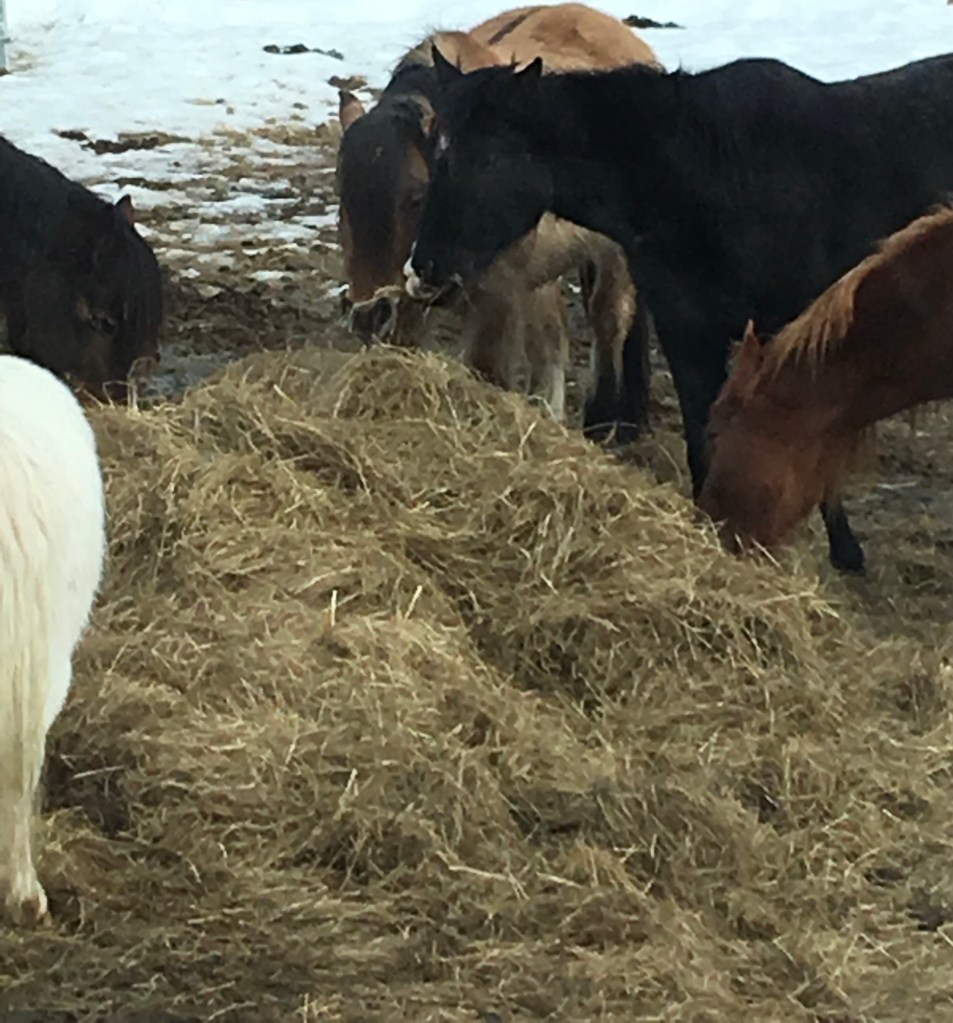
Pasture Boarding: Opt for pasture boarding instead of stall boarding. Allowing horses to graze in a pasture setting can be more cost-effective than keeping them in individual stalls and ultimately is better for the horse health as they move more and have their social needs met by living in a group.
Bulk Feed Purchases: Buy horse feed and hay in bulk to take advantage of discounts. Purchasing larger quantities can often result in lower per-unit costs. Being aware of what food you actually need prevents you from the lure of advertising. Knowing what is in a feed lets you make decisions about what else to add. All of this reduces unnecessary costs.
DIY Grooming and Basic Care: Learn to handle basic grooming tasks, such as brushing, mane-tail care, and hoof picking, sa well as training your horse to stand quietly if you need to clip him in the winter to reduce the frequency of professional grooming services.
Shared Expenses: Consider sharing expenses with other horse owners. This can include sharing transportation costs, jointly purchasing feed, or rotating duties like feeding and mucking out stalls.
DIY Maintenance: Learn to perform simple maintenance tasks, such as basic first aid, minor repairs to equipment, and routine health checks, to reduce reliance on professionals. Do you know what the temperature and breathing rate is of the average horse or how to take the pulse?
Bulk Purchase of Supplies: Buy horse care supplies, like grooming tools, bedding, and supplements, in bulk to take advantage of discounts offered by wholesalers; if you are a one horse owner, you could join together with other horse owners in your area to buy in bulk.
Educate Yourself: Invest time in learning about horse care, nutrition, and health. Understanding your horse’s needs can help prevent unnecessary expenses related to poor health or improper care. We really want to help you to know how best to help your horse so there are a range of courses available at High Coast Animal Academy to show the way in horse care, bodywork, nutrition and training.
Barter or Trade Services: Explore the possibility of bartering or trading services with other horse owners. For example, you could exchange riding lessons for help with mucking out or turn out.
Second-Hand Equipment: Purchase used horse equipment and tack. Many items, such as saddles, blankets, and grooming tools, can be found in good condition at a fraction of the cost of new ones. Learn about saddle fit (we offer a saddle fit 101 online beginners course to help you know if a saddle is safe and fits ok.)
Health Maintenance Practices: Focus on preventive health measures to avoid costly veterinary bills. Regular vaccinations, dental care, and parasite control can contribute to long-term savings by preventing health issues. Knowing how to keep your horse fit and healthy using the environment can really help. None of us can really be with our horses as much as we might like to train their bodies so how about setting up and environment that physically stretches the body while requiring movement between food and water.
Remember, while cost-cutting measures are important, it’s crucial not to compromise on the essential needs of the horse. Proper nutrition, veterinary care, and a safe living environment should always be prioritized for the well-being of your horse. That said, much can be done your self through building a good equine friendly environment and developing excellent knowledge about food and health.
Polysaccharide storage myopathy (PSSM) is a disease that results in an abnormal accumulation of glycogen (sugar) in the muscles.
Clinical signs may include reluctance to move, sweating, and muscle tremors, also known as “tying-up”.
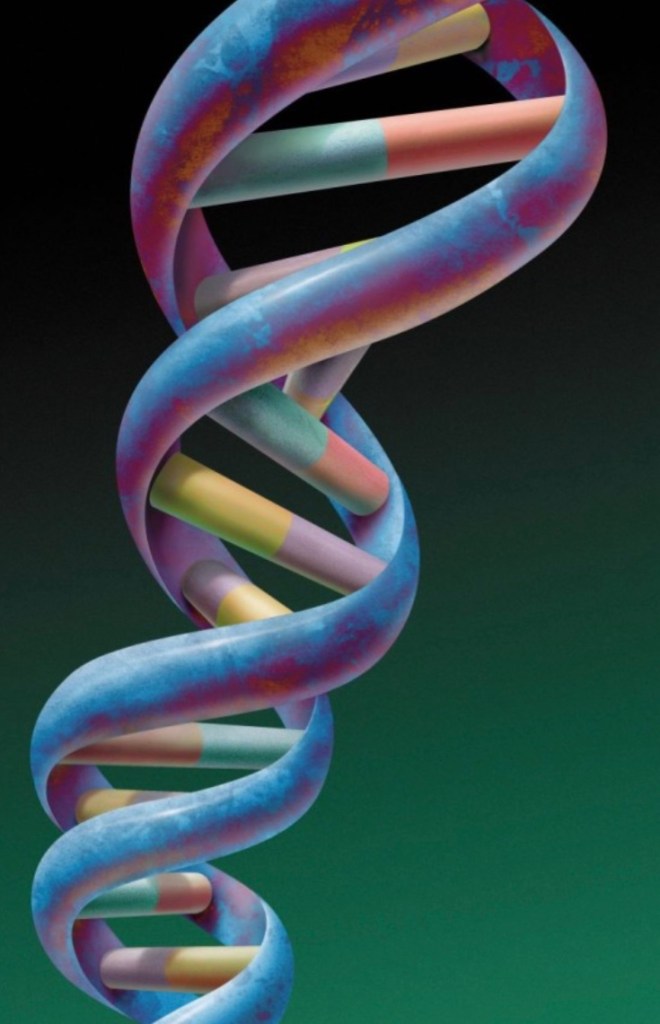
There are two types of PSSM. Type 1 is caused by a known genetic mutation and a DNA test is available. Type 2 may also be genetic, but the exact cause is unknown. There are currently no scientifically verified DNA tests for PSSM2, but a muscle biopsy can be performed for diagnosis.
There is no cure for PSSM, but most affected horses can be managed successfully through diet and exercise.
Two types of PSSM have been identified, PSSM1 and PSSM2. A genetic mutation in the glycogen synthase 1 (GYS1) gene causes PSSM Type 1 (PSSM1). The mutation causes muscle cells to produce glycogen continually. Since it is an autosomal dominant trait, only one copy of the mutation is needed for a horse to be affected. However, environmental factors, namely diet and exercise, play important roles in the onset of clinical signs. PSSM1 is more commonly observed in Quarter Horses, related breeds such as Paints and Appaloosas, and draft breeds, although cases have been reported in more than 20 breeds.
Polysaccharide storage myopathy type 2 (PSSM2) also results in abnormal glycogen storage in muscle, but horses do not have the GYS1 mutation. The cause of PSSM2 remains unknown; there may actually be multiple causes. A condition known as myofibrillar myopathy (MFM), characterized by exercise intolerance and intermittent exertional rhabdomyolysis, may be an extreme subset of PSSM2, but further research is needed. PSSM2, but not MFM, has been diagnosed in Quarter horses. Cases of PSSM2/MFM have been reported in warmbloods and Arabians. My experiences of this were with my 3/4 Arab with 1/4 Welsh section D and only seen twice when he simply stopped and quite clearly (as a very enthusiastic equine partner) could not offer very much. In both cases it was during training for endurance competitions.
The most susceptible horse breeds are American paint, quarter horse, thoroughbred cobs, warmblood, dales, new forest, Morgan Peruvian, paso fino, mustang, Lipizzaner, standard breed, Arabian and draft (bruks). Some consider that draft horses are described as more prone to PSSM as they were often fed more carbohydrates for their work in the past.
He sweated and I saw muscle tremors in his leg muscles without enormous amounts of exercise. We managed it and he continued to ride and compete as well as to live into his 40s. I will discuss management later in the blog!
Generally the clinical signs of PSSM range from mild to severe. Horses present with muscular weakness, lethargy, reluctant to rise, muscle damage, increase serum creatinine, and reduced performance.
Owners often notice the disease in terms of sweating, lameness, sore muscles, undiagnosed lameness, poor performance, and muscle tremors (“tying up”). These may occur with or without exercise.
When ridden, affected horses may be reluctant to go forward or collect.
Some affected horses, however, do not exhibit any clinical signs. This is the danger from a breeding perspective!
While PSSM1 is diagnosed with a DNA test, the tests for version 2 are more complex as there are other basis for ‘tying up’ symptoms like muscle tremors and lameness!
A muscle biopsy may be taken to evaluate muscle damage and measure the amount of glycogen in the muscle.
There are other causes for tying-up besides PSSM, including malignant hypothermia, glycogen branching enzyme deficiency, literally working on a full stomach can give a similar effect and myosin heavy chain myopathy presents similar symptoms so it is important to rule these out to ensure the horse is treated appropriately.
The process of glucose storage in the body may be helpful to consider here, before we look at management methods. Diet is one of the major management methods!
Glucose is the end product of carbohydrate metabolism. The glucose is used for the production of energy within the cell by catabolism. The unused glucose stored in the liver cell and muscle cells as glycogen (a polymer of glucose). These stored glycogen are used for energy production (Glycolysis) during the additional requirement. Any disruption of the process leads to glycogen storage diseases or PSSM.
The diet should be composed of low sugar and starch, not more than 1.5 to 2% of the horse’s body weight per day. The total non-structural carbohydrate (NSC) should not be not more than 12% of the diet to keep insulin levels low and reduce glycogen storage in the muscles. The horse diet should have vitamins, minerals, protein, and fat in a balanced way, and you can add a muscle supplement to feed too.
It is important to minimize sugar and starch in the horse’s diet to prevent excessive accumulation of glycogen as dugars in the diet trigger insulin release from the pancreas, which stimulates glucose uptake into muscle and glycogen synthesis.
Horses with PSSM are highly insulin sensitive and have greater glucose uptake into muscle than other horses.
Providing a diet that is low in starch and sugar will limit the release of insulin and the stimulation of glycogen synthesis.
It is recommended that the total diet provide less than 12% of the energy from non-structural carbohydrates(NSC), though some authorities aim for less than 10%. The NSC value is calculated from the combination of ethanol-soluble carbohydrates (ESC) and starch. Affected horses are often easy keepers and management through a low-NSC grass hay and a good-quality ration balancer is usually sufficient. If additional calories are needed, a low-NSC and/or high fat feed source should be incorporated.
There are a few things to consider for lowering the NSC content of the total diet:
Eliminate concentrate feeds:These often contain processed grains that are high in starch and sugars. Many complete feeds and commercial rations are high in NSC, and not all disclose the NSC content on the label. An equine nutritionalist can be a helpful addition to the ‘team around the horse,’ in this regard.
Choose a low-NSC hay: If possible, choose a hay with an NSC value of 12% or less.
Soak the hay: Soaking hay helps reduce the level of soluble carbohydrates. Aim for 30 minutes (with warm water) or 60 minutes (with cold water) and allow it to drain for 10 minutes afterwards. Obviously this can be very hard in places where winter results in icy conditions so a naturally low NSC fodder is the better option then.
Use a slow feeder hay net: This helps extend the foraging time so that any sugars they are consuming enters the body over a longer period of time and results in lower insulin release.
Use a grazing muzzle: If fresh, lush pasture cannot be avoided, consider using a grazing muzzle to limit their intake.
Limit pasture access to the early morning: Another option for lowering sugar intake from pasture is to limit pasture access to the early morning hours when the plants naturally have lower sugar levels.
Use a track system to support both movement and ’trickle feeding.’
Note that one should never try to lower the NSC content of a horse’s diet by underfeeding forages (grass, straw and hay). Not providing adequate forage can lead to other issues such as gastric ulcers, behavioural problems and hind gut dysfunction.
Always aim to feed 1.5 – 2% of the horse’s ideal weight (note the word ideal here) as forage. This is equivalent to 7– 9 kg (15 – 20 lbs) of hay per day for a 500 kg (1100 lb) horse
Horses with PSSM can (and should) work and exercise and even compete so what about the extra calorific needs of a working life? Fat offers a really good solution here!
Fat does not trigger insulin release and will not be stored as glycogen in muscle. Therefore, if your horse requires additional energy beyond what they are getting from their forage, fat is the preferred choice.
Horses with PSSM can have up to 20% of their caloric needs met by fat. This is best achieved with fat sources that are high in triglycerides which are easily digested and absorbed in the small intestine.
If the horse requires additional calories, a common recommendation is to add 0.5 kg (1 lb) of dietary fat for a 500 kg (1100 lb) horse. This can be accomplished by adding 2 cups of oil to their feed.
One of the important issues in diet is accurately scoring the condition of the horse. Once this is done, horses with a score of 4 or lower should have supplementary fat, while those who are at the ‘fat end of the spectrum’ need increased exercise.
Fat can in fact be a treatment method for PSSM horses. In a small study of 4 horses, exercise tolerance improved in horses fed diets providing 12% of calories from fat instead of 7%. This diet had lower starch content (3% compared to 21% of calories from starch). (Reported in J Vet Intern Med2004;18:887–894 ‘The Effect of Varying Dietary Starch and Fat Content on SerumCreatine Kinase Activity and Substrate Availability in EquinePolysaccharide Storage Myopathy’ was studied by W.P. Ribeiro, S.J. Valberg, J.D. Pagan, and B. Essen Gustavsson)
Low NSC fats appropriate for horses would include; omega3 rich oils like flax. Ground flax can be fed directly which is very oily, containing around 40% oil on average without making into or storing as an oil.
Rice bran can be fed as a source of fat.While it consists of approximately 20% fat, it also contains high levels of phosphorus, which needs to be appropriately balanced with calcium in the diet.
A special oil called w-3 oil offers DHA sourced from algae, which has shown to be very useful in the management of PSSM. It claims to offer the benefits of fish oils without the fish taste and smell which is off putting to many horses. Fish oils (salmon or cod liver) are also a good source of omega 3 and calories but not a normal source of food for the equine digestive tract.
Fat sources need to be introduced slowly to avoid digestive upset. For oils, start with 30 ml (1 oz) and increase it every 3-4 days to reach the desired amount over a 2-3 week period.
Feeding a low-NSC, high-fat diet can have additional benefits including reducing the risk of laminitis, colic and gastric ulcers.
These horses need an adequate source of selenium and vitamin E.
Selenium and vitamin E are important antioxidants that support healthy muscle function and recovery from exercise. PSSM horses with low vitamin E and selenium intake may be more prone to muscle cramping and stiffness.
Vitamin E and selenium work together, so if the horse is deficient in one of these nutrients, the other cannot function properly.
The American National Research Council Nutrient Requirements of Horses recommends a vitamin E intake of 500 – 1000 IU for a mature horse at maintenance.
To avoid selenium deficiency, the NRC recommends at least 1 mg selenium per day. The optimal intake is closer to 2 – 3 mg per day.
For horses prone to exertional rhabdomyolysis, it is recommended to provide 1500 – 2500 IU of vitamin E and 3 mg of selenium in the total diet.
Always choose organic/chelated sources of selenium and avoid over-feeding to prevent symptoms of selenium toxicity. The upper tolerable intake of selenium for a 500 kg (1100 lb) horse is 20 mg per day.
Ensure the horse has a good supply of amino acids appropriate to his or her needs.
Muscle atrophy is a common symptom of PSSM that can be partially mitigated by providing adequate levels of key amino acids in the diet.
For PSSM horses, the most appropriate strategy for providing adequate amino acid supply is to add protein or amino acid sources on their own, rather than as part of a complete feed. This helps minimize unwanted starch and sugars in the diet.
Other protein sources that provide a good balance of essential amino acids to support muscle growth and maintenance include:
Alfalfa hay or cubes
Soybean meal
Canola meal
Hempseed meal
Flaxseed meal
Whey protein
Well balanced amino acid blends from a reputable feed company
The quantity of additional protein or amino acids that may be required will depend on the protein content of the hay offered to the horse. For horses in light to moderate exercise, the protein content of moderate-quality hay is typically sufficient to meet their needs.
If management of the dieteliminates the use of complete feeds and concentrates from the horse’s feeding plan to lower the overall NSC content, it may unintentionally create a nutrient deficiency in the horse’s diet.
Horses almost never obtain all of the vitamins and minerals they require from forage alone.
In addition to selenium and vitamin E, some of the vitamins and minerals that are important for supporting metabolic health and muscle function include:
Zinc
Copper
Magnesium
B-vitamins
It is recommended to provide a low-inclusion, comprehensive vitamin and mineral supplement to ensure the horse’s needs are met without oversupplying calories. Selecting a supplement that does not contain high-NSC fillers is a really important part of the dietary management so it is important to read the ingredients in any supplement used and to understand what information is or is not offered on feed and supplement packets.
Horses must exercise daily to maximize the muscles’ ability to burn glycogen. Stress is also reported to be a triggering factor for some horses so living outside in a stable herd can be a great solution for such horses.
Exercises include walking, lunging or long lining, riding and turnout.
Warming up before and cooling down after exercise becomes even more important. The exercise aims to help to burn the carbohydrate within the bloodstream, and less glucose will deposit to the muscle cells. As such it is important not to do too much heavy exercise without breaks to lower level exercises.
Resting should be more gentle movement and less stabling.
Complete rest and living in a stable and small paddock environment should be absolutely avoided.
These horses need movement (but then I would argue so do all horses)!
I would suggest that some stable vices, such as pacing round and around and weaving over doors may come from horses who need to keep moving to reduce the fear of ‘tying up’ from too much glycogen in the muscles. The more we limit their ability to do what we consider bad, the more aversive the environment becomes both to their body and then their sense of well-being.
Living in a larger group with more movement in larger older mixed grass and herb pastures or on tracks has been shown to promote greater movement and more overall fitness in horses generally so it is a good solution for horses with PSSM.
Since small management changes can have a big impact, fine-tuning the diet and exercise regimen over time may be necessary. Competition is not necessarily avoided and even for a high performance horse, PSSM can be managed through turn out, diet and exercise, stretching and appropriate time spent in warm up and chill down activities.
Medicines
In some cases, sedatives, analgesics, muscle relaxants, and non-steroidal anti-inflammatory drugs (NSAIDs) may be used to provide pain relief, especially for short periods after active episodes of tying up.
There is less evidence-based data available regarding management of horses with PSSM2 than those with PSSM1, but they are often treated similarly.
Equine therapists can also offer good solutions for acute bouts of tying up in the early stages through the use of muscle relaxing and activating tools (electrotherapies like ultrasound, laser, tens and PEMF) as well as massage and stretching techniques alongside an understanding of nutrition and exercise physiology which means they can offer good quality advice and management plans for such horses.
One of the biggest management issues for me was organising appropriate low level exercise when I wasn’t available to ride (ie when I needed to work or be away from the farm for a time). I found creating an environment with natural challenges the best approach – I moved to a farm on a mountain with rocks and undulations –
So long before the invention of a ‘paradise paddock track system,’ I accidentally created this for him and his field friend (an elderly and rather rotund pony) by having a local gamekeeper drop hay at the top of the field on his way to feed his pheasants and keeping the water at the bottom so that movement was vital for him.
Prognosis is good for horses with the condition if it is recognised and managed. In one study, 50% horses managed with diet alone improved to within ‘normal exercise tolerances.’
One theory I have read on Swedish Trav sites is that a number of unsuccessful race horses may have PSSM. The prevalence among a range of different other breeds besides those mentioned above isn’t known or researched yet. I recently read an article about American thoroughbred racehorses (flat racing gallop) after which two or three social media comments from veterinary experts suggested PSSM as one of a number of potential explanations for problems in training described in the article.
My point is that this may be a little more prevalent than we thought where horses have been bred more and more for a purpose without genetic testing.
Common management practices of horses living in stable and stall environments may cause a PSSM environment in which horses with a tendency toward the PSSM 2 may develop symptoms because of lack of a natural balance of searching for fodder and moving to do so while running from a few predators along the way.
Track systems and other environmental developments offer a great hope for these horses, while living in a herd (or mini-herd) results in both movement and some social structure with a minimising in unnatural stresses ( herd life of course carries its own stresses)!
One natural response from owners and trainers to seeing a horse that is lame or physically tired is to give them time off in a stable or small paddock. While quite literally‘ what the doctor ordered’ for a tendon or ligament strain, this practice unfortunately does not help the PSSM horse recuperate. It can in fact cause a worsening of symptoms. Once the horse is able to move (during a tying-up period they may not be able to), turn out in a calm environment is the best option with perhaps a friendly and unchallenging companion. (More horses and a larger turn out is built up over time.) Slow hand walking and shorter turn out periods can be introduced in the very early stages of rehabilitation after an extended bout of PSSM symptoms. Return to work will follow a program of rehabilitation exercises determined by the equine therapist/ equiterapeut or equine physiotherapist and veterinary team. Often the veterinary surgeon will take blood samples in the beginning of rehabilitation to establish a baseline (this is especially important in asymptomatic horses diagnosed as a part of DNA testing).
A program may be similar to the following;
Daily light, uncollected work on a lunge-line or under saddle, starting with just 3 – 5 minutes per day at a walk and trot. It is more important torestrict the duration of a single exercise than the intensity.
The duration of work can be increased by two minutes every day. Once they reach 15 minutes of exercise, provide a five-minute walking break after each 15-minute interval of trotting. Continue with this for at least three weeks before introducing work at a canter.
Re-introduction to collected work should also be done very gradually, beginning with just 2-5 minute periods of collection under saddle followed by an opportunity to rest and stretch.
If more than 3 – 4 days elapse without adequate exercise, it is important to start back with just a small amount of exercise and build from the beginning even if the speed of building to full work is more rapid than after a bout of symptoms.
Summary
PSSM1 is a relatively common genetic condition affecting a range of breeds. It leads to excessive and abnormal glycogen accumulation in muscle resulting in stiffness, muscle pain and increased risk of tying-up (exertional rhabdomyolysis).
PSSM2 is an inherited conditionresulting in the same symptoms as PSSM1 but with an unknown genetic origin. It affects primarily warmbloods and Arabians.
Fortunately, PSSM1 and PSSM2 can be managed through diet and regular exercise. Provide a low NSC diet to limit glycogen accumulation in the muscle.
An equine therapist can advise and help throughout the process alongside the veterinary team.
Use fat instead of starches and sugars if additional calories are required. Gradually introduce exercise in short intervals to support glycogen breakdown and decrease the risk of tying-up.
Dietary management can have a significant positive impact on the health and comfort of PSSM horses, and help to minimize the need for costly veterinary care.
Valberg, S.J., Williams, Z.J., Finno, C.J., Schultz, A., Velez-Irizarry, D., Henry, M.L., Gardner, K., Petersen, J.L. 2022. Type 2 polysaccharide storage myopathy in Quarter Horses is a novel glycogen storage disease causing exertional rhabdomyolysis. Equine Vet j. E-pub ahead of print.
Valberg, S.J., Finno, C.J., Henry, M.L., Schott, M., Velez-Irizarry, D., Peng, S., McKenzie, E.C., Petersen, J.L. 2020. Commercial genetic testing for type 2 polysaccharide storage myopathy and myofibrillar myopathy does not correspond to a histopathological diagnosis. Equine Vet J 53(4):690–700.



 Happy Healthy Horses