As spring is firmly knocking on the door even here in the north of the north, with longer days and the whiff of warmth in the air, we usually begin to get ready in earnest for the new year of competitions and shows with our horses and ponies.
Even for those of us who do not intend to compete but will wander the lanes and hills for picnic rides, it is good to fitten up both horse and rider.
So where do we begin?
If you go to a personal trainer or gym, you will expect certain markers and goals to begin with. Knowing your weight, height, resting heart rate, resting breathing rate, recovery time (the time it takes your heart and breathing to go back to normal after strenuous exercise) and so on. You will usually set a goal – to run a 5k – to be able to walk to the kitchen without puffing – the goal doesn’t matter but it is good to know where you are starting from and where you are heading!
So now let’s think of a pony or horse who has been comfortably accommodated all winter, doing relatively little (perhaps the odd ride or wander, or even a few lessons). There is a difference in fitness levels clearly between a puissance athlete and my relatively fat (sorry Teddy) Welsh section a, but the principles around fitness for life are similar to fitness for a particular sport. I can’t take dear old Teddy and expect him to take me straight out on a sled tour if he has done precious little for 6 months; I must work progressively to get him fit, taking time at each stage to ensure that he doesn’t become overworked and so suffer (or be at bigger risk from suffering) injury from his training.
Level of fitness: Consider both your horse’s and your own current level of fitness. Give yourself time, and where needed have easier days, or a few days off to give yourself and your horse time to recover. Hammering the same exercises over and over again in the hope of building fitness is not the way forward (see my blog on cross-training) but pacing yourself and your horse can lead to much faster development and greater endurance in the long run (even more so if you have an older horse). Do you know how to take your horse’s pulse and respiration? Or how to assess their weight? It is useful to have a baseline of how your horse moves in walk and trot at least on both reins (a film is a great place to start).
Let’s think about heart rate first! It is handy to have a rough idea of what is a normal range and to be honest the easiest way to take the heart rate or pulse is with a stethoscope though you can take the pulse across the artery on the lower jaw. Stethoscopes can be acquired cheaply from pharmacies or sports departments. So below are the approximate ranges for a resting horse. Breed, age, what is happening around all alter these so it is a good idea to have a few goes at checking. We know that the resting heart rate raises when a horse is wearing a saddle, is different in different situations and with different people!
Adult Horse: 28 to 48 beats per minute. It might be interesting to know that a neonatal Foal: 70 to 110 beats per minute. (And you can hear sometimes a murmur in first two days post-foaling so don’t be immediately alarmed but keep a note.)
The heart can be heard using a stethoscope placed between the 2nd to 5th intercostal space. Horses have four heart sounds, and the full cycle sounds like “Bah-lub-dub-ah” (as opposed to “lub-dub”). In some horses, all four heart sounds can be detected, while in others only two or three heart sounds can be heard (“lub-dub” or “bah-lub-dub”). The individual heart sounds are usually not all heard at the same location as their points of maximal intensity vary.
In order to take your horse’s heart rate, stand on the horse’s left side. Place a stethoscope on the horse’s chest, tucked just under the elbow. Count the number of full beats for 15 seconds, then multiply the number by 4.
Please note;
If a horse’s heart rate is elevated at rest, an equine veterinarian should be consulted.
If any abnormal heart sounds are heard, such as any murmurs or abnormal rhythms (arrhythmia), an equine veterinarian should be consulted.
It is good to get used to how your horses heart sounds – changes can then be heard and you can have confidence in ringing the vet – learn all this on your healthy horse and you will have the skills to notice changes if they happen in the future! But for now we will focus on getting a baseline for your horse’s fitness.

We don’t all have access to a stethoscope and (for example when training long distance) you may want to have a quick guide as to your horse’s fitness while out on a ride so it is useful to have practice at taking the pulse!
The pulse can be felt at other peripheral (ie away from the heart) locations on the horse. These places where you could take your horses pulse include:
- The facial (mandibular) artery that crosses the lower border of the jawbone (i find this the easiest on most of mine except my very furry highland pony in the depths of a Swedish winter when all arteries and blood supply of any sort are hidden under a huge shag pile carpet on his face! )
- Stand slightly to the side of the horse’s head and cup your hand with your first two fingers along the inside of the jawbone, just below the heavy muscles of the cheek.
- Feel along the inside of the jawbone until you consistently feel the pulse beat.
- Count the beats for 15 seconds, then multiply by 4 for beats per minute.
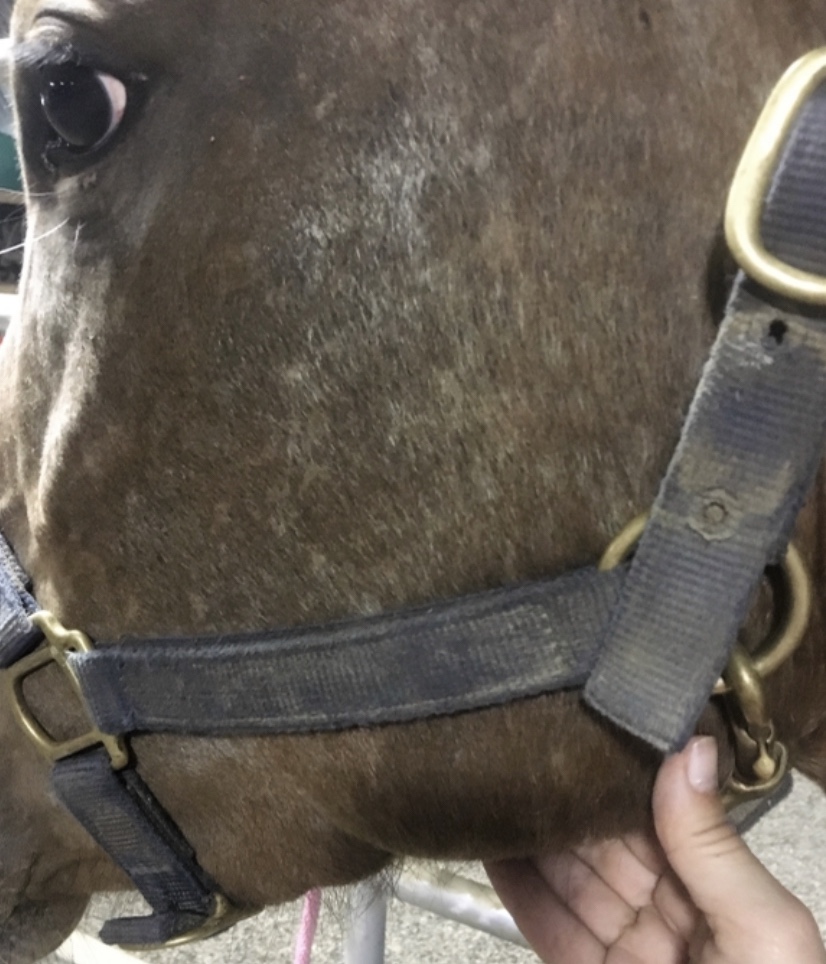
- The transverse facial artery near the eye
- Using two fingers, find the pulsing artery just below the facial crest.
- Count the beats for 15 seconds, then multiply by 4 for beats per minute.
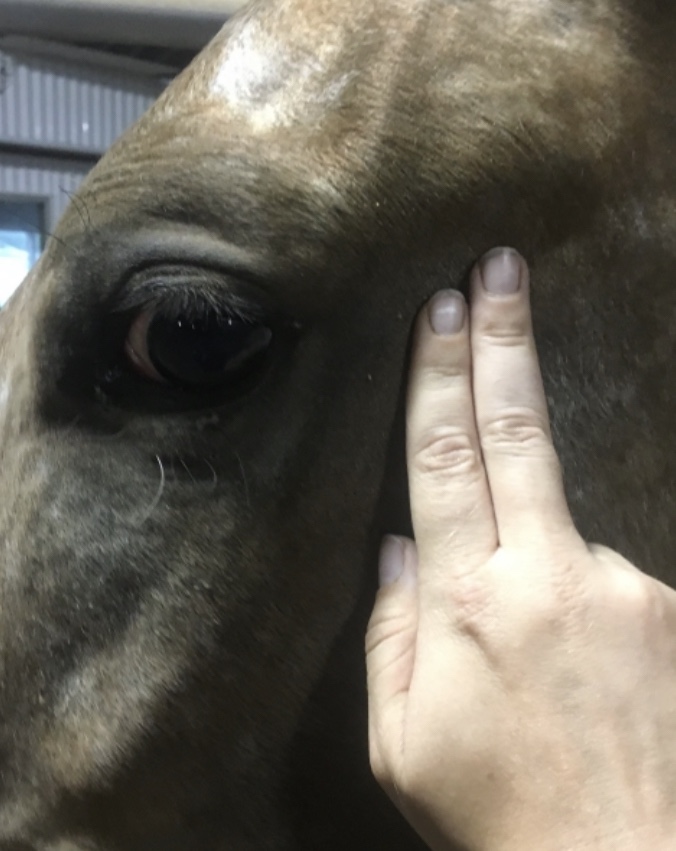
- The radial artery at the back inside of the front knee
- Crouch facing the limb, then place your hand around the back of the knee with the pads of your fingers pressing on the radial artery. (Anatomically, taking the pulse here is just like taking your pulse at the wrist.)
- Once your fingers locate the strong, consistent pulse beat, count the beats for 15 seconds and multiply by 4 for the beats per minute.
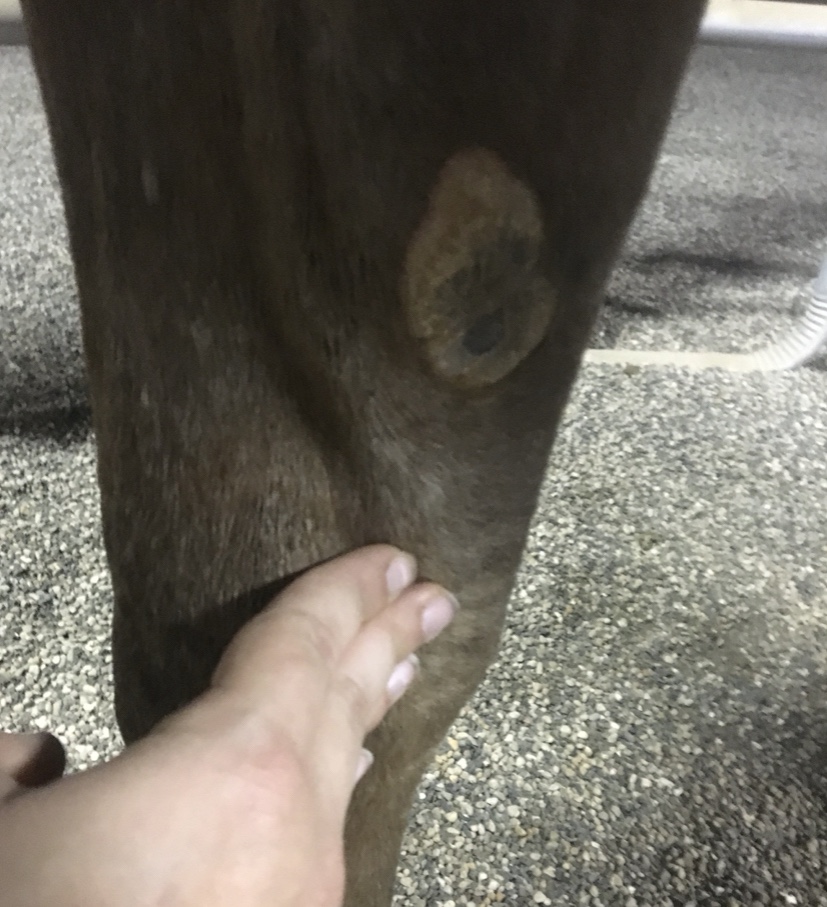
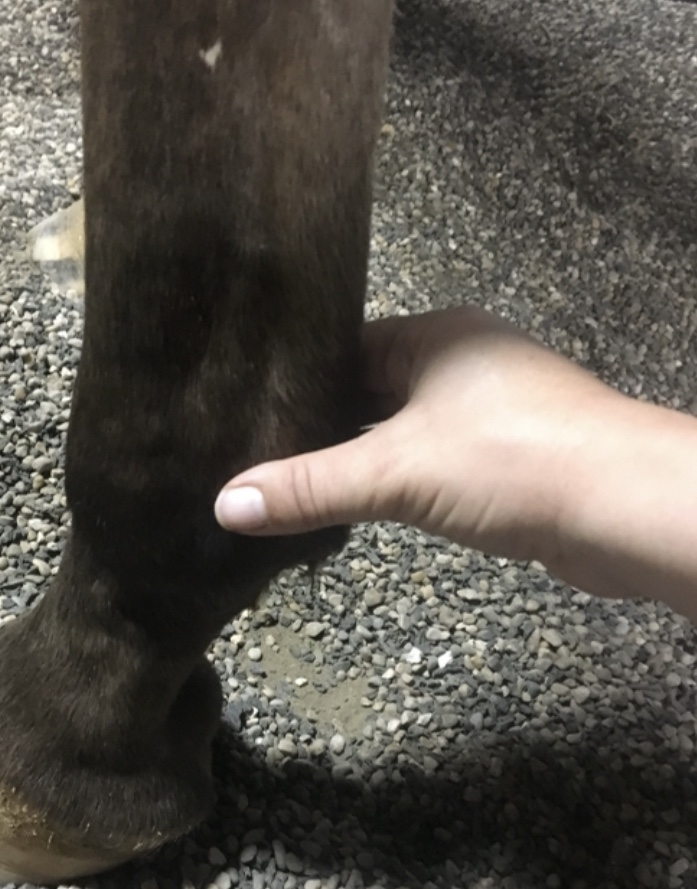
- The digital artery, located below the fetlock at the inside of the ankle
- Crouch facing the limb and locate the digital artery with the pads of your fingers. The pulse may be best found on the inside or outside branch of the digital artery.
- Place the pads of your fingers on the artery and count the beats for 15 seconds, then multiply by 4 for the beats per minute.
- This can also be helpful when dealing with a lame horse. Increased or bouncing digital pulses can indicate a problem in the foot or limb.
Next check the breathing of your horse!
Adult Horse: resting 8 to 20 breaths per minute
Neonatal Foal: resting 20 to 40 breaths per minute
Horses’ respiratory rates can be taken by either watching their sides move in and out with each breath, or feeling the air go in and out of their nostrils (I do so for 15 seconds and multiply by four and I find it more accurate to feel the breathing provided they are calm, used to it and you don’t come so near the muzzle that you tickle their whiskers!
Have a look at how your horse breathes when resting and after exercise. Get used to how he holds his chest and stomach. Remember the thoracic sling of muscles and fascia that are so essential to how he uses his back to carry you and free up his legs is also the sling that effectively holds all his vital organs in place and allows him to breathe while moving. Again getting used to exactly how your horse looks before and after exercise is going to help you train his fitness and identify if a veterinarian is required because something is clearly wrong!
I basically giving you licence to stand and look at your horse for one or two minutes at different times throughout the day and night so you know how he holds himself – it’s not just a lovely thing to do but it can be vital in identifying health issues!
Next area to consider is his or her condition when turned away: If you are bringing your horse back into work following some time off, consider their condition when turned away. For example, were they turned away sound? Are you bringing them back from an injury?
Obviously a competitively fit horse that has rested a while will have a base level of fitness that will be quicker to access than an injured or just layer off horse who hasn’t needed or had the chance to do much other than stand in a field for a year or two. Andy Murray the British tennis player came back from a hip operation rather quicker than most of us would manage as he had a good base fitness and it is not so different for our equine partners.
Consider your horse’s weight. Decide if his condition or weight is healthy and make a plan to help him or her get to a healthy weight safely. Below are some methods for assessing your horse’s weight
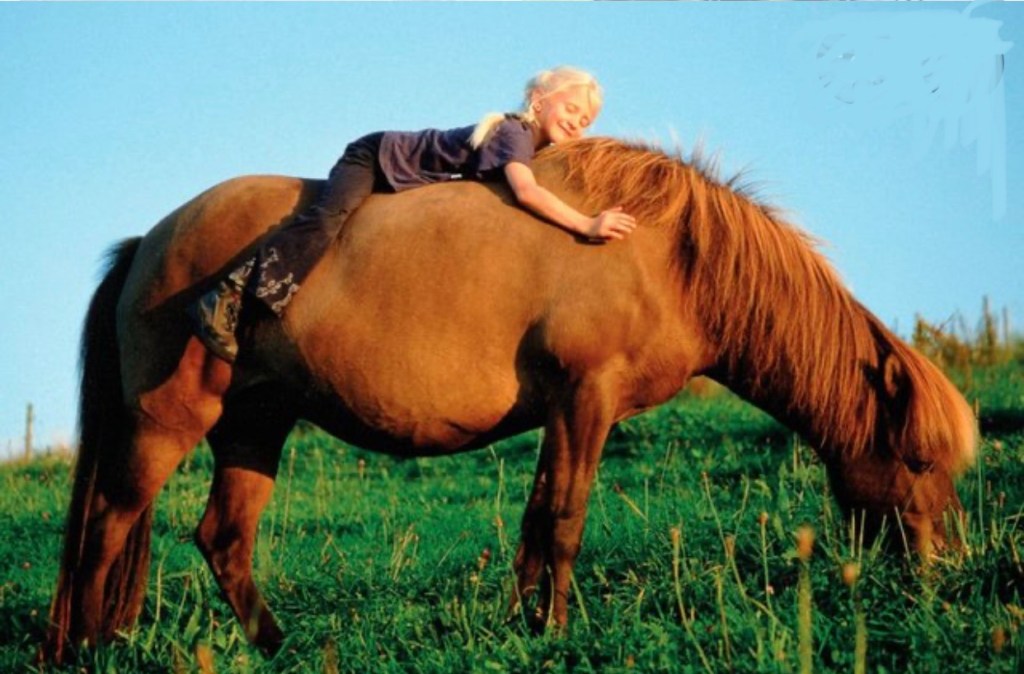
- Weighbridge
This is the only truly accurate method to measure a horse’s weight, for most people it is not an option, but if you can use one it is worth it. You can then be totally accurate with wormer and feed calculations. One way is to weigh your trailer empty then add in your horse. The difference is what your horse weighs. - Weigh-tape
In the absence of a weighbridge, a weigh-tape is an essential tool to keep in your tack box. They are cheap to buy and used regularly will help you monitor weight gain and loss, and to be more accurate with feeding and medication. The weigh-tape is used around the horse’s girth, where a roller would normally fit.
Remember to follow the instructions carefully, use the same make of tape and keep a record of the readings.
(If more than one person is using the tape, make sure you are using it in the same way, at the same time of day and in the same place each time.) - The formula
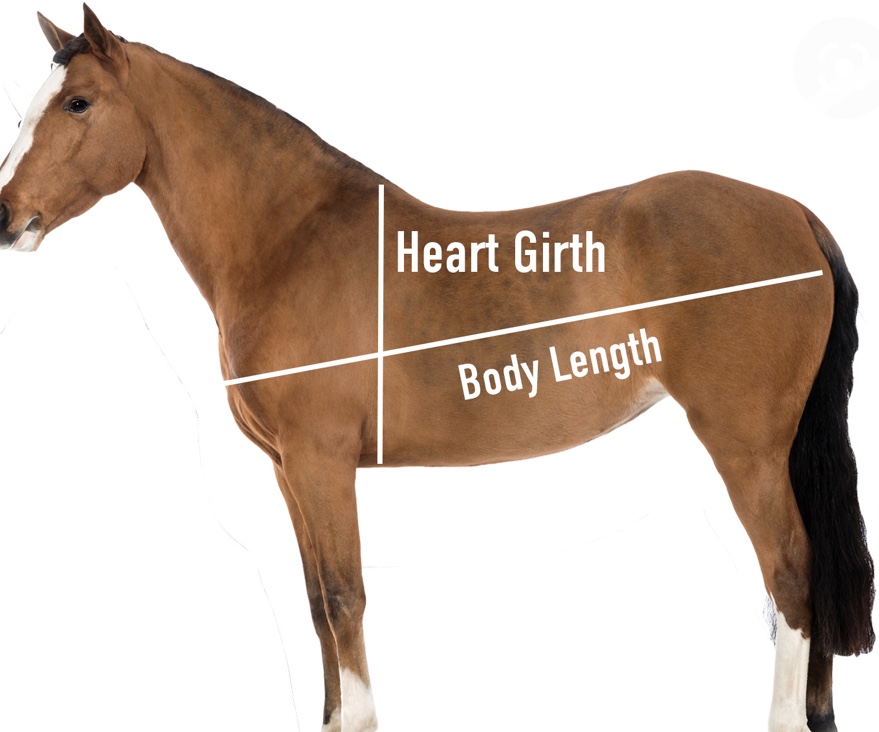
Slightly more accurate than a weigh-tape is a calculation where you measure your horse with a tape measure (in inches), and work out the weight using a formula.
The formula was developed at Texas University and it is a much better assessment than a weight ape but a little more fiddly to achieve.
The calculation: (heartgirth x heartgirth) x body length ÷ by 330. This gives the weight of the horse in pounds (lbs).
The heartgirth measurement: Take a measuring tape and measure all the way around the horse’s girth from the highest point of the wither going to just behind the elbows.
The body length: Measure from the point of shoulder in a straight line around to the point of buttock on one side.The result is in pounds (lbs). You can divide this by 2.2 to get kilograms.
- Body scoring
However accurate the weight measurements are they cannot tell you if that weight is right for your horse. For that you need to score the body condition;
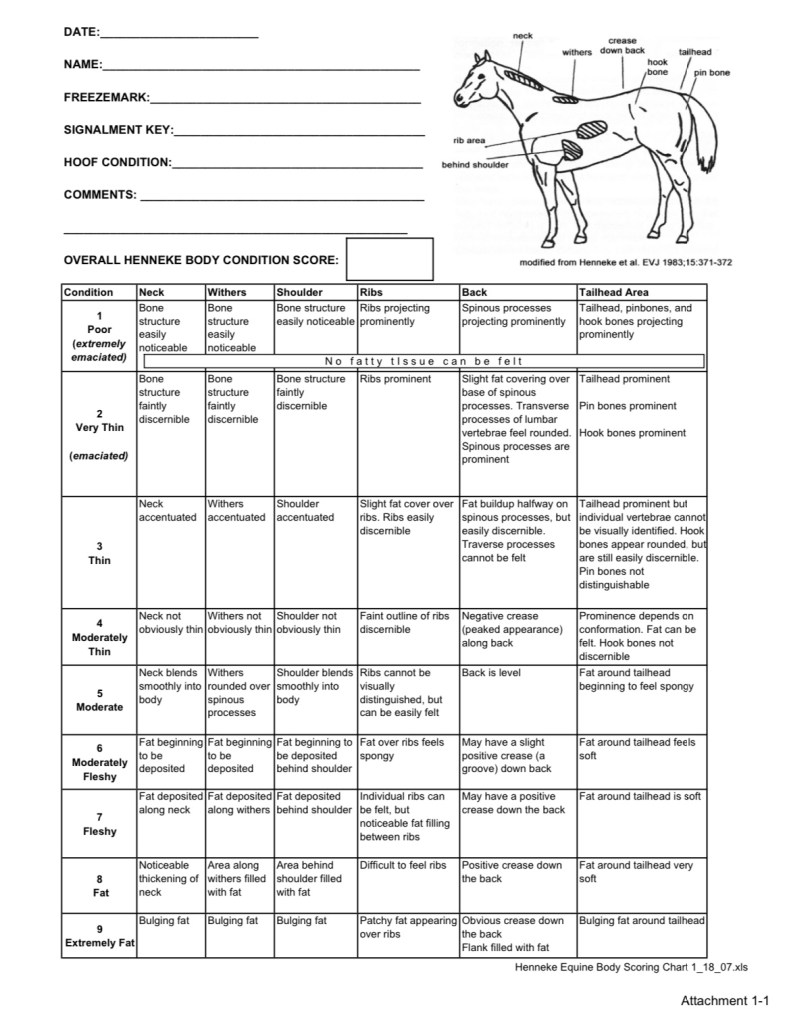
The Henneke horse body condition scoring system is a numerical scale used to evaluate the amount of fat on a horse’s body. It was developed in the early 1980s by Don Henneke at Texas A&M University with the goal of creating a universal scale to assess horses’ bodyweight, and was first published in 1983. It is widely accepted and because it has been adapted to offer us pictures of how each area appears horse owners can easily assess their horses in terms of condition and keep a note over time and in relation to feeding and exercise changes.
Six parts of a horse are checked in this system—the neck, withers (where the neck ends and the back begins), shoulder, ribs, loin, and tailhead. When using the Henneke system, you should always make physical contact with these parts, and the kind of touch you use is important. Simply stroking the animal lightly won’t provide an accurate idea of the horse’s condition; you have to apply pressure to each part in turn.
The pressure you apply should be much like that of a massage; if you press a horse’s side with your hand, you’ll be able to feel the fat covering his ribs, and get an idea of how much fat is present. Likewise, when checking the withers, feel all around the area, as if you were squeezing firm clay. It is possible to be firm and gentle at the same time, and both traits are necessary to properly score a horse.
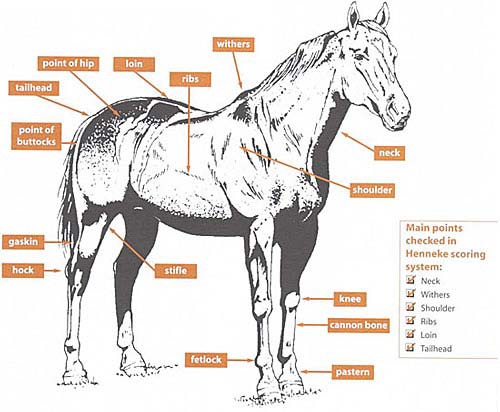
After pressing each part of the horse with your hands to feel for body fat. You then assign each area of the body the numerical score that corresponds with the horse’s condition. When a horse has a long haircoat it is imperative that you use your hands to feel the horse. The horse’s long haircoat will hide the protrusion of bones, all except in the most extreme cases. The scores from each area are then totaled and divided by 6. The resulting number is the horse’s rating on the Henneke Body Scoring Condition Chart.
Remember your own fitness too – your heart and respiration, weight and flexibility will affect your horse’s capacity to carry you. Hard as it seems sometimes for horse owners but we need to take care of our own health and fitness……if nothing else for our horse’s sake!
So now you have an idea whether your horse is in the peak of fitness; smoothe muscle, with little fat, can return to a resting pulse in just a minute or two and breathes slowly with a reasonably slow resting pulse or whether you have a couch potato in your paddock! What next? Well there was too much for one blog so this is a cliff hanger! More on Thursday!!

 Happy Healthy Horses