Overriding (or impinging) dorsal spinous processes (ORDSP), or “kissing spines”, occur when vertebrae in the spine are too close together, rather than being spaced apart as in a healthy spine. This results in touching or overlapping of two or more of the bony projections at the top of each vertebrae (spinous processes). In some horses, this can cause consistent, low-grade pain, but many horses do not exhibit any clinical signs.
The locations and number of vertebrae involved can vary. Kissing spines most commonly occur between thoracic vertebrae (T) 13 and 18, with T15 the most often affected. This is the site where the angle of the dorsal spinal process changes orientation. It is also the site directly under the saddle and the rider’s seat. Kissing spines have also been observed in the lumbar vertebrae, but this is less common.
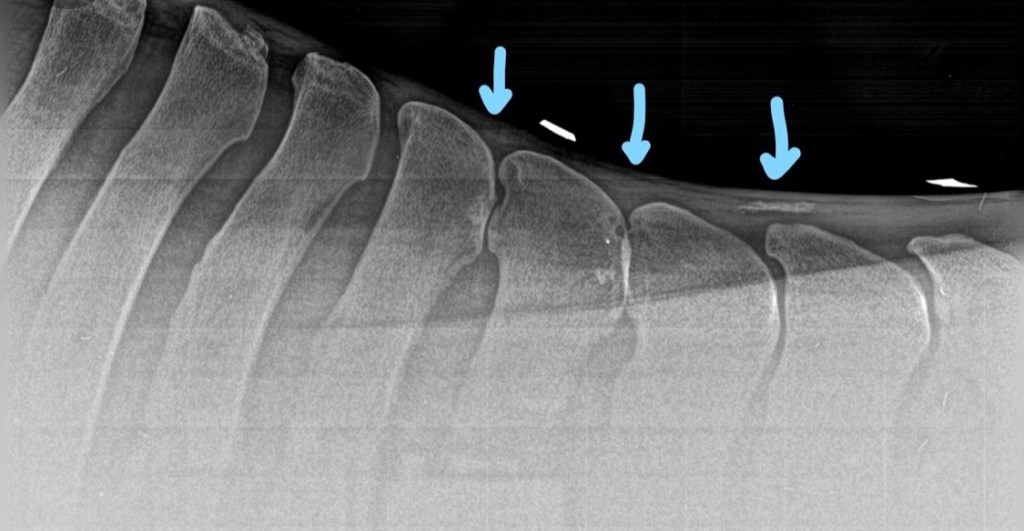
Some horses hide discomfort better than others so that it is not always easy to diagnose until the impingement has become a significant problem. Many horses with mild kissing spines do not exhibit any clinical signs ie they hide their discomfort as do most flight animals – being the slow horse in the herd can result in being the one the lions eat! For those horses that have clinical signs, those signs can be highly variable and may include vague or overt lameness and overall poor performance. Affected horses can exhibit changes in behavior such as hypersensitivity to brushing, girthiness, bucking, rearing, head tossing, kicking out, hollowing the back, resisting the bit, trouble with transitions, cross-cantering, refusing or rushing fences and kicking back at the fence after clearing it. Their backs are often sore to the touch.
Kissing spine is something most ridden horses have or will have at some point in their lives.
Let that sink in a second…….
In a study by a UK veterinary college, 80% of horses who were x-rayed for one or another issue have missing spines at the time of the X-ray. That is a lot of ridden horses.
It is also something horses are rarely if ever born with so one can guess it may be something that comes as a result of their lives with us….. (I don’t know of and could not find in the literature, any large studies of wild horse groups looking into whether they also suffer from this at points in their lives.)
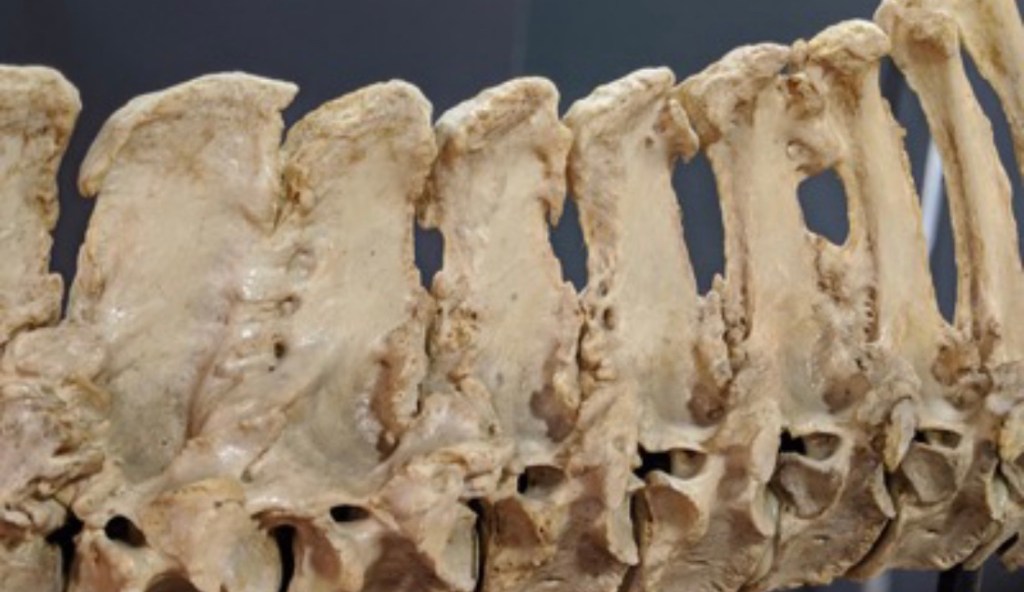
It does not represent just a birth defect or conformational problem but rather a whole systems problem that reflects a dysfunction in how the body balances it’s structures using the flexible tensions within the fascia and holds together (and apart) bony and soft tissues. This is often described as tensegrity. This word comes from design engineering and describes a design principle that applies when a discontinuous set of compression elements is opposed and balanced by a continuous tensile force, thereby creating an internal prestress that stabilizes the entire structure. There is growing interest and research into this concept related to fascia. Kissing spine can be described as a result of dysfunctional tensegrity so that the body loses the ability to maintain the integrity of its three dimensional shape while moving. Kissing spines can be described as a compensation mechanism; as such it is the body’s attempt at stabilizing the failing tensegrity by binding structures together.
The sad part is that most of this is preventable. There are clear signs and indications that this is going to happen long before there are pathological findings, however it is important not to confuse pain and kissing spines.
There are many horses that have pain and absolutely no pathological evidence on imaging. (Although perhaps, if we didn’t wait to see pathology before acting to improve the body’s balance and movement, we wouldn’t have such a severe breakdown as is seen in kissing spines).
Many horse owners struggle to fit their horse with a saddle that suits the particular back shape and the sport they want to do with the horse. This combined with a lack of education in how to build muscle correctly and the stretching and massage that can help after or before every ride, results in an upward struggle for the average horse/rider combination to avoid tensegrity and musculoskeletal problems like kissing spines.
When we see pain and/or pathology in our equine friends, finding the root cause of the pain can be complicated and tricky.
Many bodyworkers report cases that have had kissing spines surgery and still continue to work with pain and dysfunction.

There is a surprising contrast in what we do to try to relieve horses back difficulties compared with what we do for our own species! In humans (who rarely carry huge weights in their thoracic spines) with degenerative back issues, support is usually added to the structures to maintain the integrity of the spine. Rehab involves re-educating movement and exercises to strengthen and balance the body. In horses surgery effective further destabilises the structures by cutting tensioning soft tissues and shaving bone in order to create space and facilitate movement. The recommendations I have heard reported by riders are usually that after a brief period of rest the rider may return to riding their horse as usual so that the same movements (ie wearing a saddle, jumping or dressage etc as before) that may likely have contributed to the original problem are repeated after surgery. In some cases, rehabilitation exercises are offered and treatment to re-educate the body and relieve inflammation. But surely we could be educating before the horse gets to the point where surgery is considered; surely we could offer our horses a better chance by educating them to carry their body well so that a rider and tack becomes an after thought in the scheme of better tensegrity, improved muscle strength, flexibility and better movements.
Most surgeries cut the interspinous ligament to alleviate pain by allowing greater space and instability. One might question the idea that pain is alleviated in the longer term by destabilising the spine especially since clinical evidence suggests that pain can come from bone, nerves , ligament, muscle, fascia and the brain (see the work of Kevin Haussler, DVM, DC, PhD, Dipl. ACVSMR), however surgery is a common option for horse owners and riders who want to get the horse back to work as rapidly as possible.
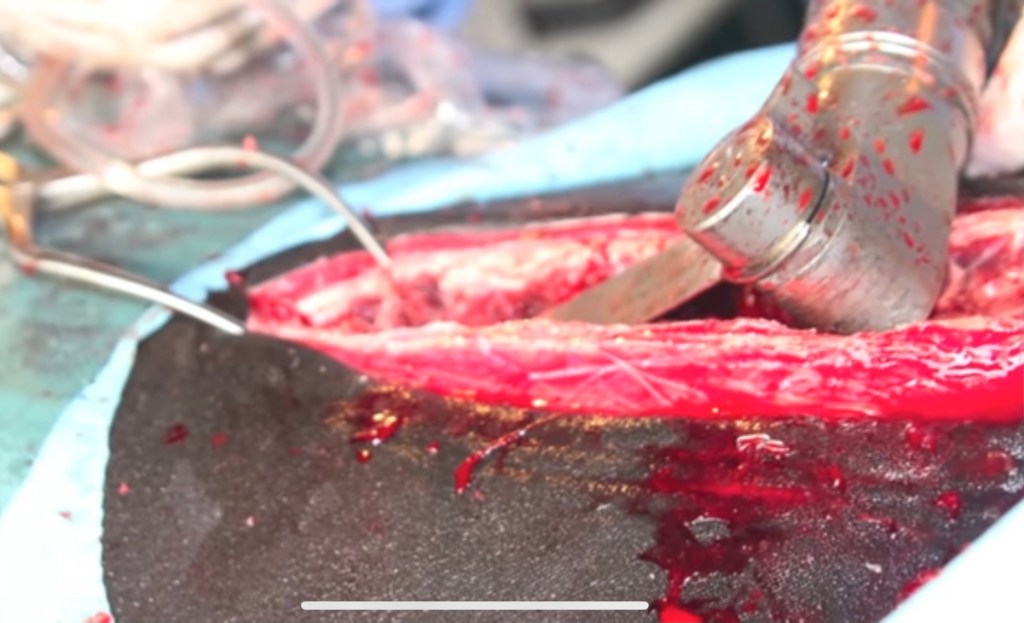
The interspinous ligament is actually a continuation of the supraspinous ligament ? This is the suspension cable that keeps your horse’s top line together and so stretches to this cable can offer a conservative (ie. non surgical approach when combined with muscle movement education and corrective tack decisions). An equine veterinary surgeon I spoke with identified a further problem for her in this kind or surgical treatment as that cutting the ligaments is not a ‘one and done’ procedure as ligaments can heal and grow back (but with scar tissue which is generally less flexible than normal tissue). She identified a frustration that for a few cases they returned, requiring a further similar procedure! A further issue connected to that is that, if the operation is done without appropriate rehabilitation afterwards, the horse returns to the same movements with the same tack and rider and one can expect similar problems to reoccur – not in every horse but in many.
Most kissing spine surgery related to the bone itself is done on the dorsal part of the spinous process. We are learning that much of the pain comes from the ventral part and the articulation on the vertebrae. Since some thoracic vertebrae have 12 points of bony articulation, it could reasonably be considered somewhat difficult for the veterinarian to be expected to find the offending one. Surely if we as horse owners and trainers took responsibility for training our horses to carry their bodies well, the veterinarians would only need to work with the most complex and difficult of injuries to the spine. Kissing spines would become an unusual specialist issue rather than a common place occurrence.
Surgery should not be the answer for the majority of horses. If we could change the way we work with our horses from the ground up (metaphorically and physically) and educate owners and trainers in saddle fitting and regular re-fitting as well as the influence of other parts of tack, feet and the rider, we would have a much better set of results abs fewer horses having their backs cut open, their bones shaved and the scars of cut ligaments and cut fascia, bone, muscle and skin.
There is much written about the importance of the thoracolumbar fascia and its proprioceptive and motion functions so we want to avoid its adverse disturbance as much as possible. Unfortunately nothing is the same in the body after surgically created scar tissue affects the thorocolumbar structures.
There are clear markers and indicators and simple therapy routines combined with good workout protocols that can turn your horse around before he or she reaches the stage where surgery is the only choice but more than that there are exercises and regular therapeutic treatment you as an owner can use to prevent this process from beginning.
It is important to learn early detection of struggling tensegrity and compromised plains of motion to prevent injury and degradation of tissues that hold our horses together
Here are some questions to help you consider your own horse and how you and your horse are working to build up his or her body for the work you do together.
Are you working with the body or against the body keeping in mind it has billions of years of smart evolution on its side as a moving flight animal?
Is your horse ready for the exercise you are asking him or her to do?
Can your horse perform the same exercise properly, using the correct muscles, without a rider and tack, then with tack but no rider?

How long since your horses saddle and girth (is the combination and relative shapes of saddle and girth/s correct for your horse, and their rider and their job) were checked?
Are your horse’s feet and angles of their feet and legs correct for the job you want them to do?
Does your horse have the correct head movement in this bridle (or lack of bridle, bit, lack of bit etc)?
Can your horse move with the neck and head relaxed in all of the exercises you are asking of him or her?
Have you built the correct muscles?
Can the rider ride in balance and without adversely affecting the horse’s movement? (If not can some of their difficulties be alleviated through bodywork, exercise and off horse training for them too?)
If you believe that there is a problem, will what you are about to do stand the test of time as in for how long will this last and can the pathology come back?
What do you consider success ? (Because if the goal is back to competitive riding after a brief spell of surgery and rest, you may have a rude awakening.)
Are you willing to do the rehab, and are you willing to put in the work and time (because if this is done right it will take a year to get back on the horse and compete)?
If your horse has post surgical pain – get him or her checked again by a veterinary surgeon.
Is the pain in the brain ? Remembered pain and neuralgia are excruciating. Phantom pain is as real as organic – just ask anyone who has had their limb removed and still feels the effects of the original injury. Be kind and take time. Allow for days when work is too much and give your horse the benefit of the doubt even years after surgery.
So what could we do?
The pursuit of mental and physical harmony with our horses has to be the ultimate riding goal. That is where the magic happens. Our traditional training methods aim to build a horse’s muscles, reactions and fitness to power him when jumping over things, galloping fast or performing impressive dressage movements. There are, though, key muscles deep within our horses that can remain weak in even very fit horses making it impossible for them to work with core fluidity, leading to self-restraint and in some cases, pain. Over the years it has become obvious that whatever the build, breed, discipline or even history, the same groups of resistances are experienced by most horses and their riders, only intensity varies. Bad backs are often disguised as schooling issues until they become severe enough to easily identify.
Core weakness shows itself initially with a heavy, one-sided contact amongst other all too familiar resistances, and can indicate the onset of ‘Spinal Crowding Syndrome’ (SCS), which is extremely common and overlooked. Unfortunately if not addressed it can ultimately lead to a ‘Kissing Spine’. ‘Ki-Equine core’ is a ridden system of exercises for horses. By precisely targeting, reversing then strengthening this inherent weakness under the guidance of the rider, the pair can together develop a permanent understanding of what improved self-carriage feels like and what to do about it.
My next blog will look at a few exercises you could use to build a better core and shield your horses back from injury.
If you would like to know more about equine Bodywork, preparing your horse for riding and competition or chat about any aspect of equine physical training or rehabilitation, please contact me @fyra.fotter on instagram or by email to ailsa@fyrafotter.se
 Happy Healthy Horses