As horse owners, we aim to provide the best welfare for our horses, but, what is good horse welfare? And, how can you determine or measure if a domestic horse has good or bad welfare?
These and many other questions have kept animal welfare scientists busy for many decades.
Since the 1990s, science has greatly improved our knowledge of animal welfare. We now know much more about the unpleasant and pleasant mental experiences animals can have and how they affect their welfare. This knowledge has led to the development of new tools that allow a thorough assessment of animal welfare. Such assessments are a regular part of welfare management and are aimed at improving the practical care of animals.
Guided by the well-known ‘Five Freedoms’ the early welfare focus was on preventing animals from having negative experiences. However, we now also know that animals are able to have positive experiences (e.g. pleasurable tastes whilst eating, physical comfort, enjoyable companionship, excited playfulness), which enhance their quality of life.
The Five Freedoms concept is nowadays an inadequate tool for assessing animal welfare due to some key points. Firstly, the Five Freedoms concept does not refer specifically to positive experiences. Secondly, it disregards the role some negative experiences have in keeping animals alive. Thirdly, it refers to only a small proportion of the mental experiences animals can have. An alternative to the Five Freedoms is therefore needed. Dr Mellor has developed a model now named the five domains as a more appropriate framework for looking at animal welfare and this model can be applied to how we care for our horses as much as how wild, agricultural or zoo animals are cared for.
The Five Domains Model is a modern tool, designed by Professor Emeritus David Mellor for guiding systematic and thorough assessments of animal welfare states. The Model incorporates the understanding that mental experiences, be they negative or positive, are a reflection of an animal’s internal states (e.g. hunger leading to feed intake; vitality stimulating play behaviour) or external circumstances (e.g. threat from attack leading to fear; presence of conspecifics leading to pleasures of being bonded). The Model therefore focusses on identifying the internal and external conditions that give rise to mental experiences. The sum of all mental experiences represents the welfare status of an animal at a given time.
The aim is to keep negative experiences as mild and as few as possible and to enable animals to also have positive experiences, with the goal of achieving an overall positive quality of life balance.
After all isn’t that what we all want for our beloved equine partners?
Prof. Mellor has served on numerous national and international animal welfare advisory committees and has wide experience of integrating scientific, veterinary, industry, consumer, animal welfare, legal, cultural and ethical interests while developing animal welfare standards, regulations and laws.
Although officially retired, Prof. Mellor has taken a keen interest in sport horse welfare and was invited to assist New Zealand Thoroughbred Racing (NZTR) in developing a new welfare strategy based on the Five Domains Model of Welfare Assessment, a model he developed and is used in many areas, from farming to zoos.
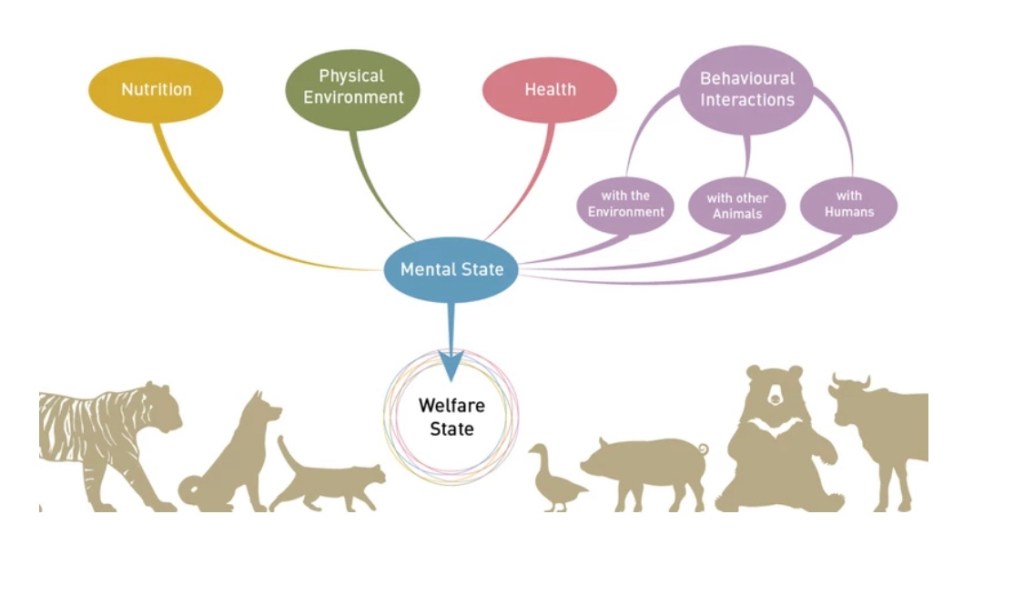
The General Welfare Aims are a practical translation of the Five Domains of the Model, namely:
1) ‘Nutrition’,
2) ‘Physical Environment’,
3) ‘Health’,
4) ‘Behavioural Interactions’
5) ‘Mental State’.
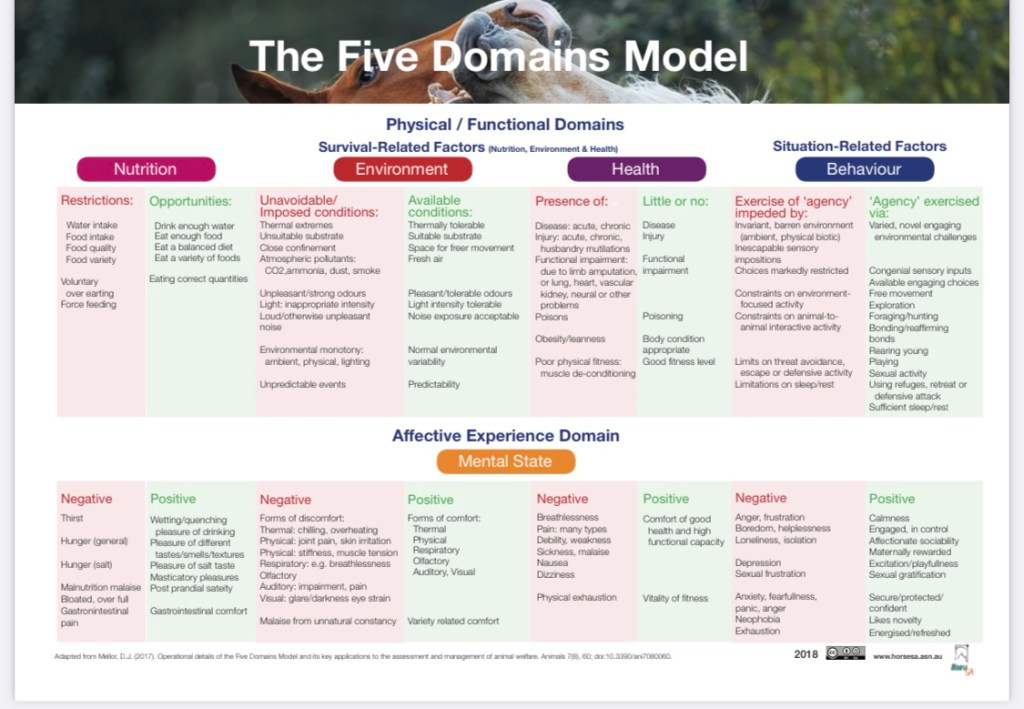
Affects resulting from the first three functional domains lead to animals performing behaviours aimed at restoring internal stability and are referred to as ‘survival-critical affects’. The fourth domain is concerned with the conscious actions animals perform in pursuit of specific goals in relation to the environment, other animals and humans, generating ‘situation-related affects’. The totality of generated affects from the first four domains – assigned to the fifth domain – represent the animal’s subjective experience of wellbeing.
In order to comprehensively assess the welfare state of an animal under human care, it is important to evaluate the impact of human presence and behaviour on the animal. Handling, training, medical treatments, and caring for an animal are situations where the interaction between humans and animals can lead to either negative or positive mental experiences. The valence of these experiences, i.e. their positive or negative outcomes, will vary depending on, for example: prior contact with humans, preexistence of threatening circumstances, intended or unintended harm, level of bonding with specific humans, provision or denial of access to resources, and participation in common activities of either a pleasant or unpleasant nature.
Horses are sentient – defined in many countries laws as the capacity to have positive and negative experiences that matter to it and affect its welfare, and the five domains model is a very good vehicle for exploring, understanding, managing, and assessing those experiences. Because of this, rules regarding the equipment that can and should be used, the tolerances for exercise, athleticism and control within sports and the conditions in which horses are kept ( bearing in mind their natural choices rather than what we as humans see as pretty or comfy) should be under constant review and rules/laws and frameworks should be applied with a bias towards the individual horse and their own needs and preferences.
Sentience matters because it acknowledges what animal welfare scientists implicitly and explicitly have been thinking for three or four decades.
Accepting sentience in the fields of racing and performance sports formally puts a stake in the ground to say that animals are not merely commodities; they are beings that can often have really negative experiences and, if given the opportunity, can also have really positive experiences.
If you take an animal welfare point of view, the principle would be that it is acceptable to use animals for our purposes with two provisos;
- that the purpose is acceptable (which is where the concept of social licence to operate fits in), and,
- that the ways the animals are used are humane.
And the humane component may be assessed by using the five domains model. Our equipment (bits, nose bands, shoes, saddles, bridles even blankets and bandage boots ) can all be looked at through the five domains lens.
The acceptability by the wider public of the ways we use animals, aligns with the extent to which the animal’s welfare is compromised or enhanced by what we are doing, (and that any compromise that we can’t get rid of is suitably compensated for by what we are doing). We need to go carefully in our language when describing species specific behaviour in human terms – a horse that exhibits horseness for example isn’t being naughty – just horsey!
The social licence comes from the recognition of the welfare balance and whether or not that use is regarded as acceptable by the wider public.
References;
Mellor DJ. Updating Animal Welfare Thinking: Moving beyond the “Five Freedoms” towards “A Life Worth Living.” Animals. 2016;6(10). doi:10.3390/ani6100059
2. Farm Animal Welfare Council. Second report on priorities for research and development in farm animal welfare. FAWC, Ministry of Agriculture, Fisheries and Food, Tolworth (Now DEFRA, London). 1993.
3. Mellor DJ. Operational details of the five domains model and its key applications to the assessment and management of animal welfare. Animals. 2017;7(8). doi:10.3390/ani7080060
4. Mellor DJ. Moving beyond the “Five freedoms” by Updating the “Five Provisions” and Introducing Aligned “Animal Welfare Aims.” Animals. 2016;6(10). doi:10.3390/ani6100059
5. Mellor DJ, Beausoleil NJ, Littlewood KE, McLean AN, McGreevy PD, Jones B, Wilkins C. The 2020 Five Domains Model: Including Human–Animal Interactions in Assessments of Animal Welfare. Animals. 2020;10(10):1870. doi:10.3390/ani10101870
 Happy Healthy Horses